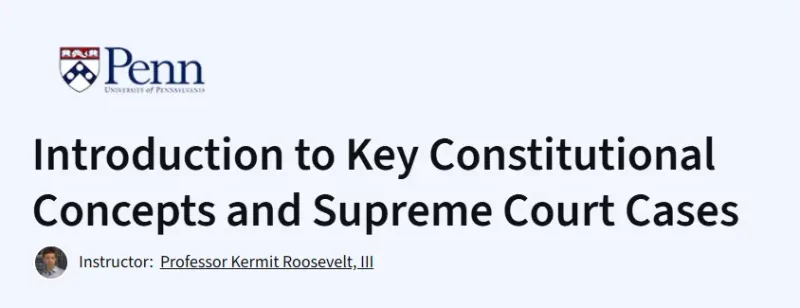
What will you learn in Introduction to Key Constitutional Concepts and Supreme Court Cases Course
-
Core principles behind the U.S. Constitution and their philosophical origins.
-
How constitutional structures protect liberty through limited government.
-
The meaning and importance of separation of powers and federalism.
-
Key constitutional debates, including judicial review and modern interpretations.
Program Overview
Module 1: Introduction to the Constitution
⏱️ 1 week
-
Topics: Declaration of Independence, natural rights, purpose of government.
-
Hands-on: Analyze Jefferson’s principles in relation to constitutional foundations.
Module 2: The Structure of the Constitution
⏱️ 1 week
-
Topics: Articles I–III, checks and balances, republicanism.
-
Hands-on: Compare structural safeguards to modern governance.
Module 3: Federalism
⏱️ 1 week
-
Topics: Division of power, enumerated powers, 10th Amendment.
-
Hands-on: Case studies on state vs. federal authority.
Module 4: The Judiciary
⏱️ 1 week
-
Topics: Article III, judicial review, role of courts.
-
Hands-on: Examine the implications of Marbury v. Madison.
Module 5: The Bill of Rights
⏱️ 1 week
-
Topics: First Ten Amendments, civil liberties, incorporation doctrine.
-
Hands-on: Interpret real-world conflicts using constitutional protections.
Module 6: The Progressive Challenge
⏱️ 1 week
-
Topics: Modern reinterpretations, living Constitution, administrative state.
-
Hands-on: Critically reflect on constitutional evolution in the 20th century.
Get certificate
Job Outlook
-
Beneficial for educators, civil service aspirants, legal assistants, and public policy students.
-
Equips learners with foundational constitutional literacy—valuable in law, politics, journalism, and government sectors.
-
Enhances understanding for those entering fields like teaching, public administration, or advocacy.
Explore More Learning Paths
Deepen your understanding of legal reasoning, constitutional frameworks, and the systems that shape modern governance with these carefully selected programs designed to expand your expertise.
Related Courses
-
A Law Student’s Toolkit Course – Build essential legal reasoning skills, interpret complex texts, and strengthen your ability to analyze legal arguments.
-
Introduction to English Common Law Course – Explore the foundations of common law, its core principles, and how it influences legal systems worldwide.
-
Introduction to Environmental Law and Policy Course – Understand the laws and regulatory structures designed to protect the environment and guide public policy.
Related Reading
Enhance your grasp of how structured decision-making and organizational principles shape legal processes:
-
What Is Management? – Learn how effective management frameworks support institutions, policy implementation, and operational efficiency.