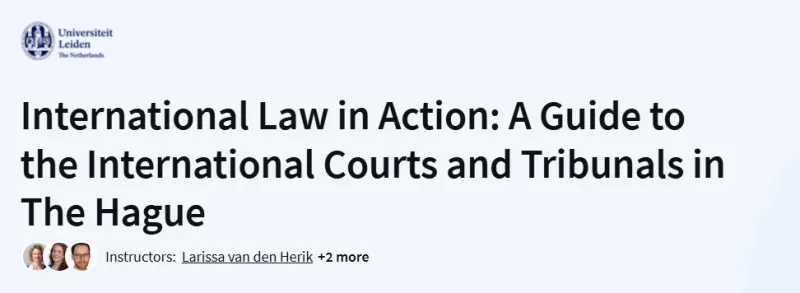
What will you in the International Law in Action: A Guide to the International Courts and Tribunals in The Hague Course
-
Gain insights into the functioning of international courts and tribunals located in The Hague.
-
Understand the roles and jurisdictions of institutions like the International Court of Justice (ICJ), International Criminal Court (ICC), and Permanent Court of Arbitration (PCA).
-
Explore the procedures and challenges involved in international dispute resolution.
-
Analyze real-world cases to comprehend the application of international law.
-
Develop a foundational understanding of how international justice is administered.
Program Overview
1. Introduction to International Law and The Hague
Duration: 3 hours
-
Overview of The Hague as the city of peace and justice.
-
Introduction to the concept and sources of international law.
2. The International Court of Justice (ICJ)
Duration: 4 hours
-
Examination of the ICJ’s role in settling disputes between states.
-
Analysis of landmark cases and advisory opinions.
3. The Arbitration of International Disputes
Duration: 3 hours
-
Exploration of the PCA’s function in resolving disputes involving states, state entities, intergovernmental organizations, and private parties.
-
Case studies highlighting arbitration processes.
4. International Criminal Courts and Tribunals
Duration: 3 hours
-
Understanding the ICC’s mandate to prosecute individuals for international crimes.
-
Discussion on the court’s structure, jurisdiction, and notable prosecutions.
5. Conclusions of the Three Course Themes
Duration: 3 hours
-
Critical analysis of the effectiveness and limitations of international courts.
-
Debates on reforms and the evolving landscape of international adjudication.
Get certificate
Job Outlook
-
International Legal Practitioners: Enhance understanding of global judicial mechanisms.
-
Diplomats and Policy Makers: Inform policy decisions with knowledge of international dispute resolution.
-
Academics and Researchers: Provide a foundation for scholarly work in international law.
-
NGO and Human Rights Workers: Equip with insights into legal avenues for justice and accountability.
-
Students of Law and International Relations: Serve as an introductory course to specialized fields.
Explore More Learning Paths
Deepen your knowledge of international law and the workings of global legal institutions with these hand-picked courses designed to expand your legal expertise and analytical skills.
Related Courses
-
Introduction to Environmental Law and Policy Course – Explore how international and domestic policies shape environmental protection and compliance.
-
Introduction to International Criminal Law Course – Gain foundational knowledge of international criminal law and its applications in global justice.
-
International Law in Action: The Arbitration of International Disputes Course – Learn how international disputes are resolved through arbitration and legal frameworks.
Related Reading
-
What Is Management? – Understand management principles that support decision-making and operations in legal and organizational contexts.