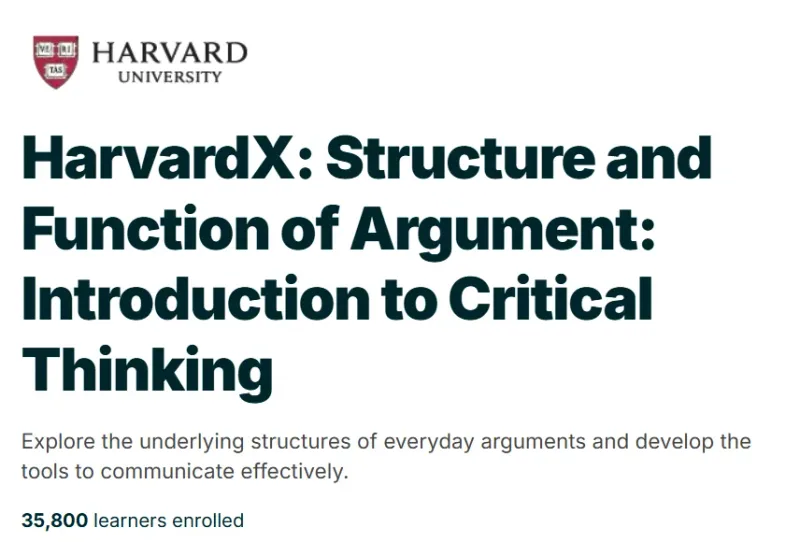
What will you learn in HarvardX: Structure and Function of Argument: Introduction to Critical Thinking course
- This course introduces the foundations of critical thinking through the analysis of arguments and logical reasoning.
- Learners will understand how to identify premises, conclusions, and hidden assumptions.
- The program emphasizes evaluating argument strength, detecting logical fallacies, and constructing sound reasoning.
- Students will explore deductive and inductive reasoning structures.
- Practical examples demonstrate how critical thinking applies to public debate, academic writing, and everyday decision-making.
- By completing the course, participants gain structured tools for analyzing information and forming well-supported conclusions.
Program Overview
Foundations of Argument Structure
⏳ 2–3 Weeks
- Identify premises and conclusions.
- Understand argument mapping techniques.
- Recognize implicit assumptions.
- Analyze reasoning clarity.
Deductive and Inductive Reasoning
⏳ 2–3 Weeks
- Differentiate deductive vs. inductive arguments.
- Evaluate validity and soundness.
- Assess probability and strength of evidence.
- Apply structured reasoning methods.
Logical Fallacies and Bias
⏳ 2–3 Weeks
- Identify common logical fallacies.
- Recognize cognitive biases.
- Analyze rhetorical persuasion techniques.
- Improve argument evaluation skills.
Constructing Strong Arguments
⏳ Final Module
- Develop clear thesis statements.
- Build logically supported arguments.
- Refine analytical writing skills.
- Apply critical thinking to real-world debates.
Get certificate
Job Outlook
- Critical thinking and logical reasoning are core competencies across virtually all professional fields, including law, business, education, journalism, public policy, and research.
- Professionals with strong analytical reasoning skills are sought for roles such as Policy Analyst, Consultant, Lawyer, Researcher, and Strategic Planner.
- Entry-level analytical roles typically earn between $55K–$75K per year, while experienced professionals in law, consulting, and leadership positions can earn $90K–$180K+ depending on specialization and region.
- Employers consistently rank critical thinking as one of the most valuable transferable skills in modern workplaces.
- This course strengthens foundational reasoning abilities applicable to academic and professional advancement.