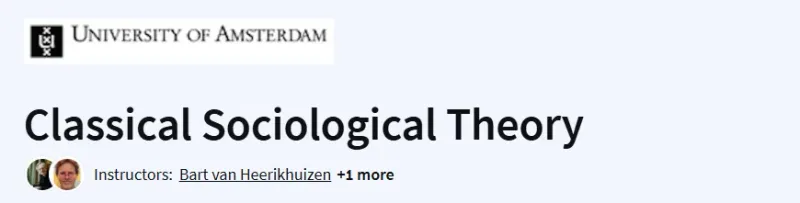
What will you in the Classical Sociological Theory Course
-
Explore foundational sociological theories from the 18th to 20th centuries.
-
Analyze the works of key thinkers such as Karl Marx, Max Weber, Émile Durkheim, Auguste Comte, and others.
-
Understand concepts like capitalism, rationalization, functionalism, social facts, and the division of labor.
-
Apply classical theories to contemporary social issues and structures.
-
Develop critical thinking skills through engagement with complex sociological texts and concepts.
Program Overview
1. Classical Sociological Theory – An Introduction
Duration: 1 hour
-
Introduction to the field of classical sociological theory.
-
Historical roots and relevance in modern societies.
-
Overview of course aims and structure.
2. Bernard Mandeville and Adam Smith
Duration: 1 hour
-
Examination of Mandeville’s “The Fable of the Bees” and its influence on Adam Smith.
-
Discussion on the division of labor and industrialization.
3. Auguste Comte
Duration: 1 hour
-
Exploration of Comte’s positivism and the “law of three stages.”
-
Understanding Comte’s vision for sociology as a science
4. Alexis de Tocqueville
Duration: 1 hour
-
Analysis of Tocqueville’s insights on democracy and equality.
-
Relevance of his work in understanding modern political systems.
5. Karl Marx
Duration: 1 hour
-
Study of Marx’s theories on capitalism, class struggle, and alienation.
-
Impact of Marxism on contemporary sociological thought.
6. Émile Durkheim
Duration: 1 hour
-
Investigation into Durkheim’s concepts of social facts, solidarity, and suicide.
-
Durkheim’s methodological contributions to sociology.
7. Max Weber
Duration: 1 hour
-
Understanding Weber’s ideas on rationalization, bureaucracy, and the “Protestant Ethic.”
-
Weber’s approach to social action and interpretive sociology.
8. Norbert Elias
Duration: 1 hour
-
Introduction to Elias’s process sociology and the civilizing process.
-
Discussion on long-term social developments and self-constraint.
9. Final Test
Duration: 30 minutes
-
Comprehensive assessment covering all course material.
Get certificate
Job Outlook
-
Sociologists and Social Researchers: Deepen theoretical foundations for academic or applied research.
-
Educators and Lecturers: Enhance curriculum with classical sociological perspectives.
-
Policy Analysts and Public Administrators: Apply sociological theories to inform policy development and implementation.
-
Nonprofit and NGO Professionals: Understand societal structures to better address social issues.
-
Students and Academics: Prepare for advanced studies in sociology and related fields.