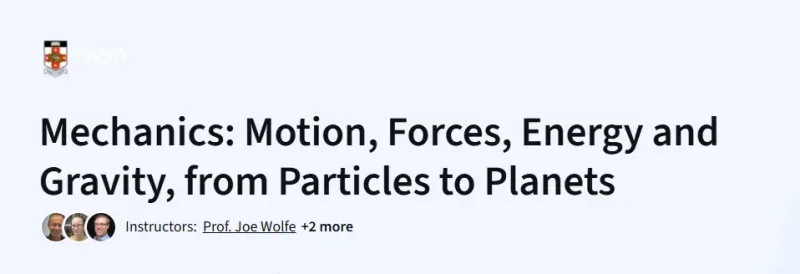
What will you learn in Mechanics: Motion, Forces, Energy and Gravity, from Particles to Planets Course
-
Understand the foundational principles of Newtonian mechanics.
-
Analyze motion and forces in everyday and astronomical systems.
-
Learn to apply conservation laws of energy and momentum.
-
Gain skills in solving physics problems from basic to intermediate level.
Program Overview
Module 1: Introduction to Forces and Motion
⏱️ 1 week
-
Topics: Newton’s Laws, motion in one dimension, acceleration.
-
Hands-on: Solving motion problems with graphs and equations.
Module 2: Energy and Work
⏱️ 1 week
-
Topics: Kinetic and potential energy, work-energy theorem.
-
Hands-on: Calculating work and energy transformations.
Module 3: Momentum and Collisions
⏱️ 1 week
-
Topics: Linear momentum, impulse, elastic and inelastic collisions.
-
Hands-on: Real-world collision scenarios and physics simulations.
Module 4: Circular Motion and Gravity
⏱️ 1 week
-
Topics: Orbits, centripetal force, Newton’s law of gravitation.
-
Hands-on: Motion analysis of satellites and planetary bodies.
Module 5: Rotational Motion and Torque
⏱️ 1 week
-
Topics: Angular momentum, torque, rotational kinematics.
-
Hands-on: Rotational systems problem sets and video explanations.
Get certificate
Job Outlook
-
Strong foundation for careers in physics, astronomy, and engineering.
-
Ideal for students preparing for STEM degree programs or exams.
-
Enhances analytical skills needed in research and space sciences.
-
High demand for physics educators and data analysts with modeling skills.
Explore More Learning Paths
Deepen your understanding of mechanics and its applications with these carefully selected courses, designed to strengthen your knowledge of motion, forces, energy, and structural analysis.
Related Courses
-
Applications in Engineering Mechanics Course – Learn practical applications of mechanics principles in real-world engineering problems, from motion analysis to system design.
-
Mechanics of Materials I: Fundamentals of Stress, Strain, and Axial Loading Course – Master the foundational concepts of stress, strain, and axial loading to understand material behavior under forces.
-
Mechanics of Materials II: Thin-Walled Pressure Vessels and Torsion Course – Explore advanced topics in torsion and pressure vessels, preparing you for complex engineering challenges.
Related Reading
- What Is Product Management – Discover how effective product management strategies drive innovation from design to production.