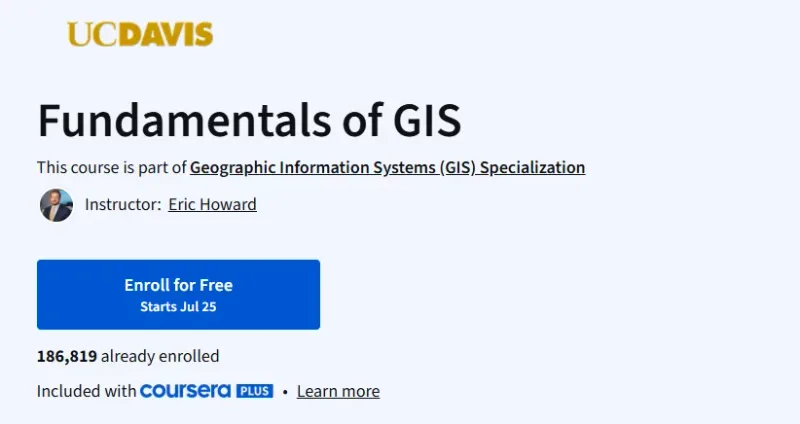
What will you learn in Fundamentals of GIS Course
-
Understand foundational concepts in Geographic Information Systems (GIS).
-
Gain hands-on experience using GIS software (ArcGIS).
-
Analyze, manage, and visualize geographic data.
-
Develop spatial thinking to solve real-world problems using maps.
Program Overview
Module 1: What is GIS?
⏱️ 1 week
-
Topics: Definition of GIS, components, applications in the real world.
-
Hands-on: Explore GIS interfaces and get introduced to ArcGIS.
Module 2: Geographic Data Models
⏱️ 1 week
-
Topics: Vector and raster data models, topology, attributes.
-
Hands-on: Work with layers and data tables in ArcGIS.
Module 3: Data Acquisition and Map Design
⏱️ 1 week
-
Topics: Sources of spatial data, coordinate systems, map design principles.
-
Hands-on: Import datasets, apply projections, and design clear map layouts.
Module 4: Spatial Analysis
⏱️ 1 week
-
Topics: Buffering, overlay, spatial queries, analytical tools.
-
Hands-on: Use ArcGIS tools to solve real mapping problems.
Module 5: GIS in Action
⏱️ 1 week
-
Topics: Practical case studies; GIS in environment, urban planning, and more.
-
Hands-on: Capstone mapping project to apply all learned concepts.
Get certificate
Job Outlook
-
High demand for GIS professionals in environmental science, urban planning, logistics, and data analysis.
-
Entry-level roles include GIS Technician, Analyst, or Cartographer.
-
Average salary: $55,000–$80,000 annually.
-
Strong freelance and consulting opportunities for GIS mapping and data visualization.
Explore More Learning Paths
Build a strong foundation in geographic information systems (GIS) and advance your spatial data skills with these carefully selected courses, designed to help you master mapping, analysis, and data management.
Related Courses
-
Geographic Information Systems (GIS) Specialization Course – Gain comprehensive expertise in GIS, from spatial analysis to advanced applications in real-world scenarios.
-
GIS Data Formats, Design and Quality Course – Learn how to manage, validate, and design high-quality GIS datasets for accurate and reliable results.
-
Introduction to GIS Mapping Course – Explore practical mapping techniques to visualize and interpret spatial data effectively.
Related Reading
-
What Is Data Management – Understand essential strategies for organizing, storing, and maintaining high-quality data in GIS and other technical fields.