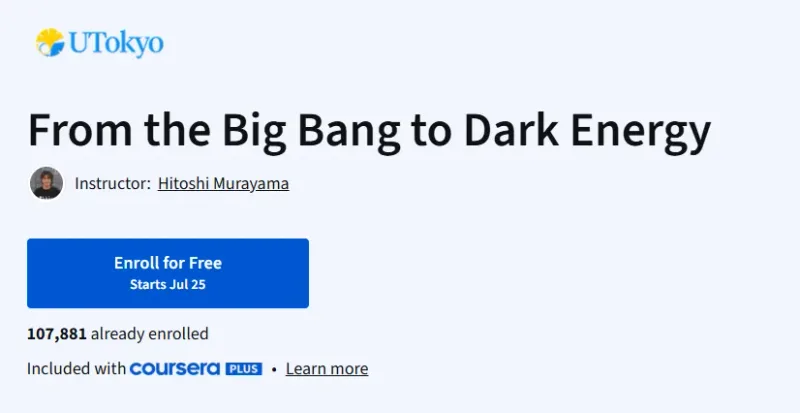
From the Big Bang to Dark Energy Course

From the Big Bang to Dark Energy Course Course

This course offers a compelling, beginner-friendly introduction to Special Relativity and cosmology. Taught with clarity and accessible analogies, it bridges physics and philosophy, making complex con...

Explore This Course
9.7/10 Highly Recommended

From the Big Bang to Dark Energy Course on Coursera — This course offers a compelling, beginner-friendly introduction to Special Relativity and cosmology. Taught with clarity and accessible analogies, it bridges physics and philosophy, making complex concepts graspable without advanced math.

Pros

  • Exceptionally clear and engaging instructor
  • Minimal math, maximum conceptual depth
  • Fascinating use of real universe mode

Cons

  • No programming or mathematical simulations
  • Limited assessment diversity

From the Big Bang to Dark Energy Course Course

Platform: Coursera

What will you learn in From the Big Bang to Dark Energy Course

  • Understand the scientific basis for the Big Bang theory.

  • Explore key concepts of Einstein’s Special Relativity.

  • Grasp how early universe conditions led to the formation of galaxies.

​​​​​​​​​​

  • Analyze the cosmic microwave background radiation.

  • Engage with thought experiments related to space and time.

Program Overview

Module 1: From Aristotle to Newton

⏱️ 1 week

  • Topics: Historical evolution of cosmological models, Newtonian mechanics, space-time concepts before Einstein.

  • Hands-on: Conceptual problem-solving quizzes.

Module 2: Einstein’s Special Relativity

⏱️ 1 week

  • Topics: Postulates of Special Relativity, simultaneity, time dilation, length contraction, Lorentz transformations.

  • Hands-on: Interactive simulations, thought experiments, and scenario analysis.

Module 3: Energy, Matter & E=mc²

⏱️ 1 week

  • Topics: Mass-energy equivalence, particle-antiparticle creation, early universe particles.

  • Hands-on: Case-based assignments and energy conversion estimations.

Module 4: The Expanding Universe

⏱️ 1 week

  • Topics: Redshift, Hubble’s Law, expanding space, implications for the Big Bang theory.

  • Hands-on: Calculations using astronomical data, expansion models.

Module 5: Early Universe & Cosmic Background

⏱️ 1 week

  • Topics: Evolution of the universe from 10⁻³⁵ seconds, cosmic microwave background, matter formation.

  • Hands-on: Analyze real CMB data visualizations and cosmological evidence.

Get certificate

Job Outlook

  • Relevance: Valuable for aspiring physicists, educators, and science communicators.

  • Academic Path: Great primer for advanced cosmology, astrophysics, and philosophy of science.

  • Career Roles: Research assistant, physics tutor, science journalist.

  • Skills Gained: Analytical thinking, conceptual understanding of time and space, public science communication.

Explore More Learning Paths

Take your engineering and management expertise to the next level with these hand-picked programs designed to expand your skills and boost your leadership potential.

Related Courses

  • Wind Energy Course – Learn the fundamentals of wind energy, turbine technology, and sustainable electricity generation systems.

  • Our Energy Future Course – Explore global energy trends, challenges, and innovations shaping a sustainable and efficient energy landscape.

  • Renewable Energy Specialization Course – Gain comprehensive knowledge of renewable energy sources, including solar, wind, and hydro, with practical applications in modern engineering.

Related Reading

Gain deeper insight into how project management drives real-world success:

FAQs

How much time should I dedicate weekly to complete the course effectively?
Estimated completion is around 4–6 weeks at a part-time pace. Weekly effort of 3–5 hours is generally sufficient for lectures and exercises. Regular engagement with visualizations and quizzes reinforces learning. Revisiting challenging concepts or exploring additional readings may require extra time. Consistent study ensures learners develop a thorough understanding of cosmology from the Big Bang to dark energy.
How relevant are the skills and knowledge for science enthusiasts or academic pursuits?
Knowledge enhances understanding of modern astronomy and physics. Concepts are relevant for science communication, research, or academic study. Understanding the universe’s structure improves critical thinking about complex systems. Awareness of recent discoveries connects learners to the scientific community. Completion demonstrates a strong conceptual grasp of cosmology.
Can this course help me understand fundamental physics concepts behind cosmology?
Learners explore gravity, relativity, and quantum concepts relevant to cosmology. Exercises and examples illustrate complex phenomena in a digestible way. Knowledge of physical laws helps explain galaxy formation and cosmic background radiation. Concepts are tied to real observations and experiments. Skills gained help learners understand ongoing discoveries in astrophysics.
Will I learn about both the Big Bang and the universe’s current expansion?
The course explains the Big Bang theory and the early universe. Learners study cosmic expansion, dark matter, and dark energy. Observational evidence from telescopes and satellites is introduced. Step-by-step examples link theory to current cosmological research. Knowledge gained provides a comprehensive understanding of the universe’s evolution.
Do I need prior physics or astronomy knowledge to take this course?
No prior physics or astronomy experience is required; the course introduces key concepts step-by-step. Basic understanding of high school-level science and math is helpful but not mandatory. Learners gradually explore the universe’s origin, structure, and evolution. Concepts are explained using clear visuals and examples. Beginners can build a solid foundation in modern cosmology.

Similar Courses

Other courses in Physical Science and Engineering Courses