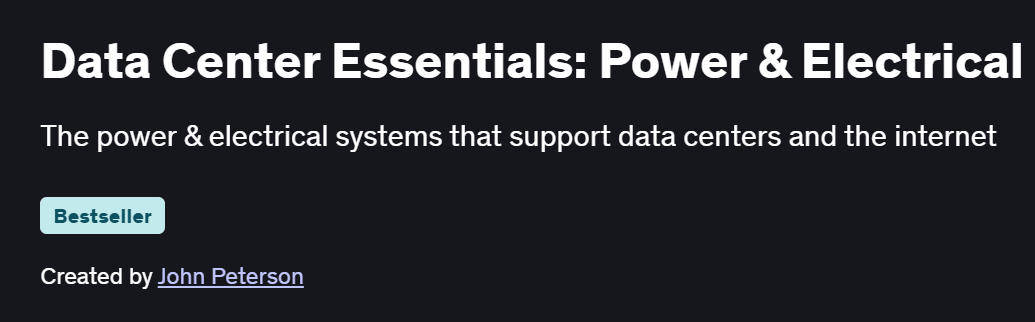
What will you in Data Center Essentials: Power & Electrical Course
- Understand data center power infrastructure: UPS systems, PDUs, and backup generators
- Interpret single- and three-phase electrical distribution, voltage, current, and power factor
- Design and size power chains for redundancy (N, N+1, 2N) and efficiency
- Implement grounding, bonding, and safety protocols to reduce electrical hazards
- Monitor and troubleshoot electrical systems using meters, SCADA, and trending tools
Program Overview
Module 1: Introduction to Data Center Power
⏳ 30 minutes
-
Overview of data center tiers, SLAs, and the role of reliable power
-
Key terminology: UPS, PDU, ATS, switchgear
Module 2: Electrical Fundamentals
⏳ 45 minutes
-
Single-phase vs. three-phase power, voltage, current, and power factor concepts
-
Real, reactive, and apparent power (kW/kVAR/kVA)
Module 3: UPS Systems & Battery Backups
⏳ 1 hour
-
Types of UPS (offline, line-interactive, double-conversion) and battery technologies
-
Sizing, runtime calculations, and maintenance best practices
Module 4: Power Distribution & Redundancy
⏳ 1 hour
-
Data center power chain architecture: utility feed, switchgear, transformers, PDUs
-
Redundancy topologies: N, N+1, 2N, and concurrent maintainability
Module 5: Generators & Transfer Switches
⏳ 45 minutes
-
Diesel generator selection, sizing, and fuel management
-
Automatic transfer switch (ATS) operation and testing
Module 6: Grounding, Bonding & Safety
⏳ 45 minutes
-
Grounding methods (TN-S, TT, IT systems) and bonding requirements
-
Electrical safety: arc flash analysis, PPE, lockout/tagout procedures
Module 7: Monitoring & Control Systems
⏳ 30 minutes
-
Using DCIM, SCADA, and power meters for real-time monitoring
-
Trend analysis, alarms, and preventive maintenance planning
Module 8: Troubleshooting & Best Practices
⏳ 30 minutes
-
Common failure modes, fault finding, and root-cause analysis
-
Energy-efficiency strategies: PUE optimization and load balancing
Get certificate
Job Outlook
-
Power and electrical expertise is critical for Data Center Engineer, Facilities Manager, and Electrical Technician roles
-
High demand in cloud providers, colocation facilities, and enterprise data centers
-
Opportunities in commissioning, maintenance, and consulting for mission-critical infrastructure
-
Foundation for advanced specializations in network-critical cooling, renewable integration, and DCIM
Explore More Learning Paths
Enhance your knowledge of data center operations with these courses designed to provide a complete understanding of power systems, mechanical infrastructure, and overall facility management.
Related Courses
-
Data Center Essentials: General Introduction Course – Gain a comprehensive overview of data center design, operations, and best practices.
-
Data Center Essentials: Mechanical & Cooling Course – Learn the principles of cooling systems, HVAC, and mechanical infrastructure crucial for reliable data center performance.
Related Reading
-
What Is Telecom Expense Management? – Discover strategies to optimize costs and manage technical resources efficiently in complex operations like data centers.