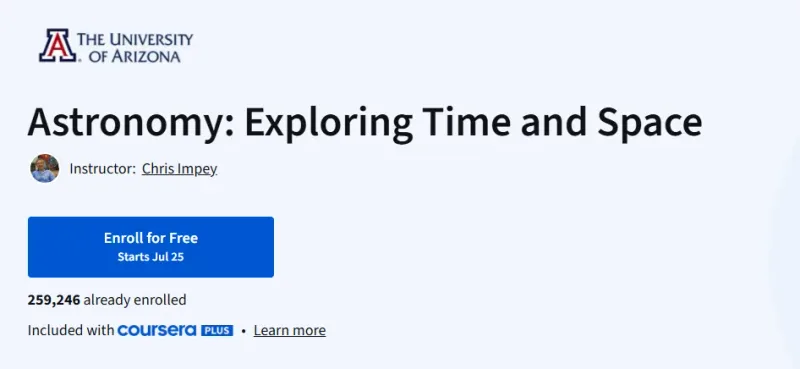
What will you learn in Astronomy: Exploring Time and Space Course
-
Grasp fundamental astronomy concepts related to gravity and space-time.
-
Understand black hole formation, properties, and detection methods.
-
Analyze how black holes interact with their environment.
-
Explore real-world astronomical data and modern discoveries in astrophysics.
Program Overview
Module 1: Gravity and the Universe
⏱️ 1 week
-
Topics: Newton’s and Einstein’s theories of gravity, warped space-time.
-
Hands-on: Visualize gravity wells and simulate planetary motion.
Module 2: Life Cycles of Stars
⏱️ 1 week
-
Topics: Stellar birth, fusion, and death; neutron stars vs. black holes.
-
Hands-on: Use simulations to track a star’s lifecycle.
Module 3: Properties of Black Holes
⏱️ 1 week
-
Topics: Event horizon, singularity, Hawking radiation, Schwarzschild radius.
-
Hands-on: Calculate escape velocities and explore black hole physics.
Module 4: Observing Black Holes
⏱️ 1 week
-
Topics: Gravitational lensing, accretion disks, LIGO, and Event Horizon Telescope.
-
Hands-on: Interpret astronomical images and gravitational wave data.
Module 5: Black Holes and Modern Physics
⏱️ 1 week
-
Topics: Quantum mechanics, general relativity, and information paradox.
-
Hands-on: Analyze thought experiments and real scientific models.
Get certificate
Job Outlook
-
While the course is more academic than vocational, it lays a strong foundation for careers in:
-
Astrophysics research
-
Astronomy education
-
Data science in space applications
-
-
Skills in data interpretation, critical thinking, and scientific literacy are transferable across STEM fields.
-
Strong pathway to graduate studies in physics or astronomy.
Explore More Learning Paths
Take your curiosity about the universe even further with these curated courses and readings designed to deepen your understanding of space, discovery, and scientific analysis.
Related Courses
-
Astrobiology and the Search for Extraterrestrial Life Course
Explore how scientists search for life beyond Earth by studying extreme environments, planetary conditions, and biological signatures. -
AstroTech: The Science and Technology Behind Astronomical Discovery Course
Understand the instruments, sensors, and techniques that power today’s most advanced astronomical discoveries.
Related Reading
-
What Does a Data Scientist Do
Learn how data-driven research, computational tools, and analytical modeling play a crucial role in interpreting celestial observations and advancing astronomy.