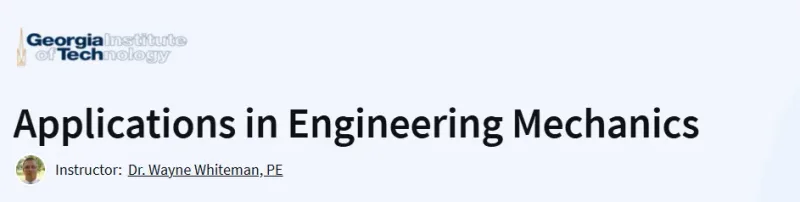
What will you in the Applications in Engineering Mechanics Course
-
Apply static equilibrium principles to complex engineering systems
-
Analyze multi-force members, frames, and machines in real-world structures
-
Solve plane and space trusses using methods of joints and sections
-
Construct shear force and bending moment diagrams
-
Understand cable support systems and applications of friction in engineering
Program Overview
Module 1: Applications of Static Equilibrium
Duration: ~3 hours
-
Review of equilibrium conditions
-
Analysis of multi-force members and structural systems
-
Introduction to frames and machines
Module 2: Plane Trusses
Duration: ~3 hours
-
Determining member forces using method of joints
-
Use of method of sections for efficient analysis
-
Identification and use of zero-force members
Module 3: Space Trusses and Shear & Moment Diagrams
Duration: ~3 hours
-
Spatial analysis of three-dimensional truss systems
-
Fundamentals of shear force and bending moment diagrams
-
Techniques for plotting internal forces in beams
Module 4: Cable Support Systems
Duration: ~3 hours
-
Analysis of cables under point and distributed loads
-
Practical engineering scenarios involving flexible cables
Module 5: Coulomb Friction and Belt Friction
Duration: ~3 hours
-
Static and kinetic friction in mechanical systems
-
Frictional applications in belt drives and contact surfaces
Get certificate
Job Outlook
-
Mechanical Engineers: Gain stronger analysis skills for designing mechanical systems
-
Civil Engineers: Apply statics principles in structural and construction projects
-
Aerospace Engineers: Understand stress and force distribution in aircraft components
-
Educators and Students: Build or teach foundational and advanced statics concepts
Explore More Learning Paths
Expand your understanding of engineering mechanics with these related courses and resources. These learning paths will help you apply core principles to real-world engineering problems.
Related Courses
-
Introduction to Engineering Mechanics
Build a strong foundation in the fundamental concepts of engineering mechanics and their applications. -
Mechanics of Materials I: Fundamentals of Stress, Strain, and Axial Loading
Learn about material behavior under stress and strain, and how axial loads affect structural elements. -
Mechanics of Materials II: Thin-Walled Pressure Vessels and Torsion
Explore advanced topics like torsion, thin-walled pressure vessels, and their engineering applications.
Related Reading
-
What Is Project Management
Discover how project management principles support successful engineering design and execution.