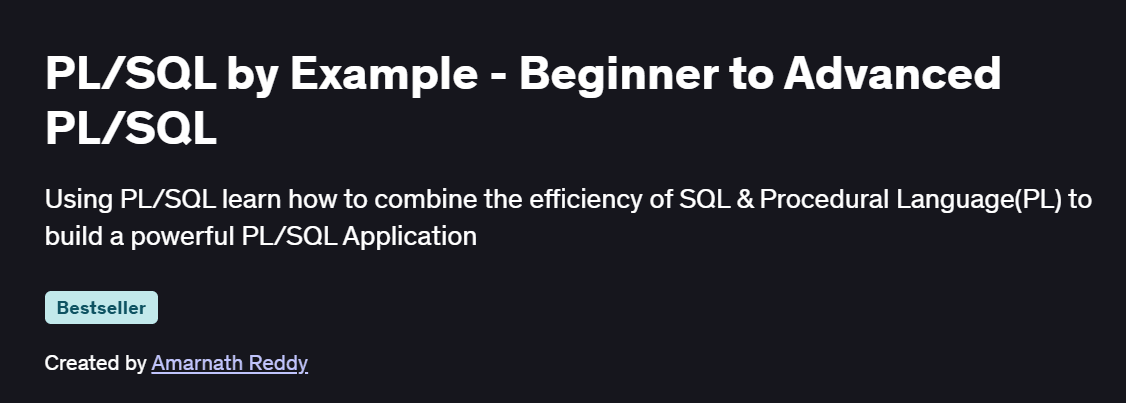
PL/SQL by Example – Beginner to Advanced PL/SQL Course

PL/SQL by Example – Beginner to Advanced PL/SQL Course Course

This course offers a Comprehensive coverage of PL/SQL concepts with practical examples.

Explore This Course
9.5/10 Highly Recommended

PL/SQL by Example – Beginner to Advanced PL/SQL Course on Udemy — This course offers a Comprehensive coverage of PL/SQL concepts with practical examples.

Pros

  • In-depth coverage of PL/SQL topics.
  • Hands-on exercises and real-world examples.
  • Lifetime access to course materials.
  • Suitable for both beginners and intermediate learners.​

Cons

  • Some advanced topics may require additional resources for deeper understanding.
  • Limited focus on integration with other programming languages.​

PL/SQL by Example – Beginner to Advanced PL/SQL Course Course

Platform: Udemy

What you will learn in PL/SQL by Example – Beginner to Advanced PL/SQL Course

  • Gain a solid understanding of PL/SQL, Oracle’s procedural extension to SQL, enabling you to write efficient and reusable code.

  • Learn to create and manage stored procedures, functions, and triggers to automate database tasks.

  • Understand how to handle exceptions and errors in PL/SQL to ensure robust and reliable applications.

  • Explore advanced topics like cursors, collections, and dynamic SQL to handle complex data operations.
  • Develop skills to optimize PL/SQL code for better performance and scalability.

Program Overview

Introduction to PL/SQL

2 hours

  • Overview of PL/SQL and its advantages over SQL.
  • Setting up the development environment.
  • Basic syntax and structure of PL/SQL blocks.

Variables and Data Types

1.5 hours

  • Declaring and initializing variables.

  • Understanding different data types in PL/SQL.

  • Working with constants and literals.

Control Structures

2 hours

  • Using conditional statements (IF, CASE).

  • Implementing loops (LOOP, FOR, WHILE).

  • Handling exceptions and errors.

Cursors and Records

2.5 hours

  • Understanding implicit and explicit cursors.

  • Fetching and processing cursor data.

  • Using records to handle multiple columns.

Collections and Bulk Processing

2 hours

  • Working with associative arrays, nested tables, and VARRAYs.

  • Performing bulk operations with FORALL and BULK COLLECT.

  • Optimizing performance with bulk processing.

Dynamic SQL and Advanced Topics

2.5 hours

  • Constructing and executing dynamic SQL.
  • Using DBMS_SQL for dynamic queries.
  • Advanced PL/SQL features and best practices.

Get certificate

Job Outlook

  • High Demand: Proficiency in PL/SQL is essential for roles such as Oracle Developer, Database Administrator, and Backend Developer.

  • Career Advancement: Mastery of PL/SQL can lead to opportunities in database design, performance tuning, and enterprise application development.

  • Salary Potential: Professionals with strong PL/SQL skills often command higher salaries due to their ability to manage and optimize complex database systems.

  • Freelance Opportunities: PL/SQL expertise is in demand for freelance projects involving database development, optimization, and automation.
FAQs

Is PL/SQL still relevant in today’s data-driven world?
Yes, PL/SQL is still widely used because millions of enterprise systems run on Oracle databases. It remains crucial for data-heavy applications, especially in finance, banking, and telecom. Modern cloud platforms like Oracle Cloud also support PL/SQL development.
Can I practice PL/SQL without buying Oracle software?
Yes, Oracle offers a free version called Oracle Database Express Edition (XE). You can also practice using Oracle’s free online environments like Oracle Live SQL. Many third-party tools support PL/SQL as well.
How is PL/SQL different from other programming languages?
PL/SQL is tightly integrated with Oracle databases. It allows developers to write procedures, triggers, and packages directly in the database. Unlike Python or Java, it’s not general-purpose but specialized for managing large-scale data efficiently.
What kind of jobs require PL/SQL skills?
PL/SQL is widely used in database administration, backend development, and data analysis. Roles include Database Developer, Data Engineer, and Oracle PL/SQL Programmer. Many finance, telecom, and retail companies rely heavily on PL/SQL for applications.
Do I need to know SQL before learning PL/SQL?
Yes, a basic understanding of SQL helps a lot. PL/SQL builds on SQL by adding programming features like loops, conditions, and exceptions. If you know how to write basic SQL queries, you’ll grasp PL/SQL faster.

Similar Courses

Other courses in Office Productivity Courses