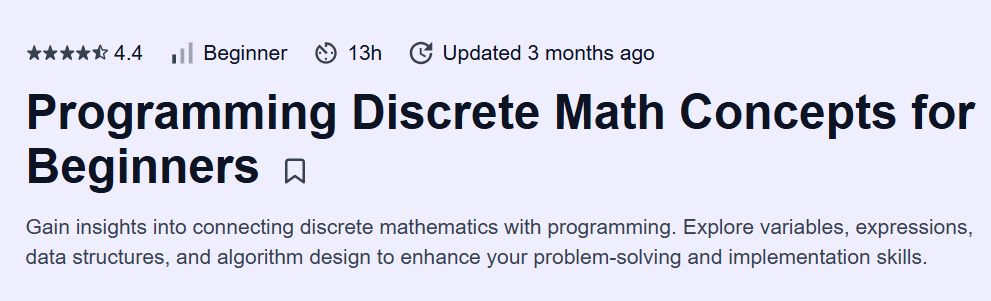
What will you learn in Programming Discrete Math Concepts for Beginners Course
-
Understand how discrete mathematics underpins data structures and algorithm design
-
Translate mathematical concepts—Boolean algebra, logic expressions, set operations—into working code
-
Implement and manipulate fundamental data structures (arrays, linked lists, trees) using object-oriented principles
-
Analyze algorithmic complexity, apply binary tree traversals, and perform set-difference and string-rearrangement operations
-
Gain hands-on practice through quizzes and coding challenges in six different programming languages
Program Overview
Module 1: Course Introduction
⏳ 10 minutes
-
Topics: Foundations of discrete math in programming; relationship to algorithms and data structures
-
Hands-on: Explore how variables, expressions, and arrays emerge from mathematical principles
Module 2: Programming Languages & Boolean Algebra
⏳ 30 minutes
-
Topics: Logical operators, truth tables, short-circuit evaluation in code
-
Hands-on: Solve quizzes on grade-threshold and temperature logic using Boolean algebra
Module 3: Logical Expressions & Algorithms
⏳ 1 hour
-
Topics: De Morgan’s Laws, control constructs, Sieve of Eratosthenes, Euclid’s GCD, Quicksort
-
Hands-on: Implement and test each algorithm; quiz on logical expression transformations
Module 4: Arrays & Discrete Mathematics
⏳ 1 hour
-
Topics: Array manipulations, indexing math, sequence patterns, basic combinatorics
-
Hands-on: Complete challenges on array-based prime detection and set-difference operations
Module 5: Linear Data Structures & OOP
⏳ 1 hour
-
Topics: Class-based implementation of stacks, queues, and linked lists
-
Hands-on: Write and test methods for insertion, deletion, and traversal in multiple languages
Module 6: Trees & Traversals
⏳ 1 hour
-
Topics: Binary tree structure, pre-order, in-order, post-order traversals, recursive vs. iterative approaches
-
Hands-on: Build tree nodes and traversal functions; quiz on traversal order
Module 7: Complexity, Set Operations & Strings
⏳ 45 minutes
-
Topics: Big-O notation, set-difference algorithms, string-rearrangement techniques
-
Hands-on: Analyze algorithmic complexity and solve a string-shuffle coding challenge
Module 8: Review Quizzes & Coding Challenges
⏳ 1 hour
-
Topics: Consolidation of key concepts across modules
-
Hands-on: Complete 9 quizzes and 12 multi-language coding challenges to solidify learning
Get certificate
Job Outlook
-
Proficiency in discrete math and algorithm implementation is essential for roles like Software Engineer, Data Scientist, and Systems Architect
-
Discrete math skills underpin work in fields such as cryptography, network design, and optimization—salaries range $90,000–$140,000+
-
Mastery of these foundations accelerates success in competitive coding interviews and advanced computer-science coursework
Explore More Learning Paths
Strengthen your mathematical foundations for computer science with these hand-picked programs designed to enhance your understanding of discrete math, statistics, and computational thinking.
Related Courses
-
Introduction to Statistics Course – Learn key statistical concepts and techniques to analyze data effectively, an essential skill for computer science and analytics.
-
Mathematical Thinking in Computer Science Course – Develop problem-solving and logical reasoning skills to tackle computational challenges with confidence.
-
Introduction to Discrete Mathematics for Computer Science Specialization Course – Explore discrete structures, combinatorics, graph theory, and algorithms relevant to programming and computer science applications.
Related Reading
Gain deeper insight into how structured knowledge enhances computational thinking:
-
What Is Knowledge Management? – Understand how organizing and applying mathematical and technical knowledge supports efficient problem-solving in computer science.