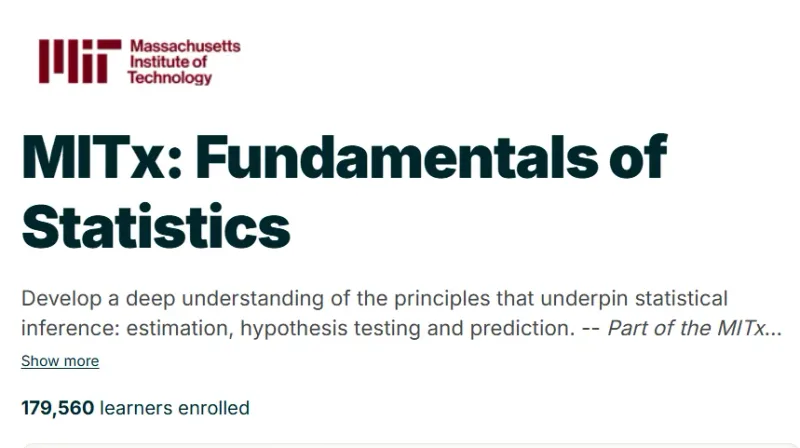
What will you learn in MITx: Fundamentals of Statistics course
- This course provides a comprehensive introduction to statistical thinking, covering probability theory, data analysis, and inference techniques used in science, engineering, and business.
- Learners will gain a strong mathematical foundation in probability distributions, random variables, expectation, and variance.
- The course emphasizes hypothesis testing and confidence intervals to help students make data-driven decisions with statistical rigor.
- Students will explore regression analysis and modeling techniques to understand relationships between variables.
Program Overview
Probability Foundations
⏳ 3–4 Weeks
- In this section, you will build a strong base in probability theory.
- Learn about random variables, probability distributions, and expected value.
- Understand discrete and continuous distributions such as binomial, geometric, and normal distributions.
- Develop mathematical intuition behind uncertainty and randomness.
Statistical Inference
⏳ 4–6 Weeks
- This section introduces methods for drawing conclusions from data.
- Learn about sampling distributions and the Central Limit Theorem.
- Construct confidence intervals for means and proportions.
- Perform hypothesis testing and interpret statistical significance.
Regression and Data Modeling
⏳ 4–6 Weeks
- Here, you will explore relationships between variables using statistical models.
- Learn simple linear regression and model interpretation.
- Understand correlation, residual analysis, and model assumptions.
- Apply regression techniques to real-world datasets.
Advanced Statistical Concepts
⏳ 3–4 Weeks
- This final section strengthens deeper statistical understanding.
- Explore maximum likelihood estimation concepts.
- Understand bias, variance, and model evaluation.
- Learn how statistical reasoning supports decision-making in research and industry.
Get certificate
Job Outlook
- This course provides a comprehensive introduction to statistical thinking, covering probability theory, data analysis, and inference techniques used in science, engineering, and business.
- Learners will gain a strong mathematical foundation in probability distributions, random variables, expectation, and variance.
- The course emphasizes hypothesis testing and confidence intervals to help students make data-driven decisions with statistical rigor.
- Students will explore regression analysis and modeling techniques to understand relationships between variables.