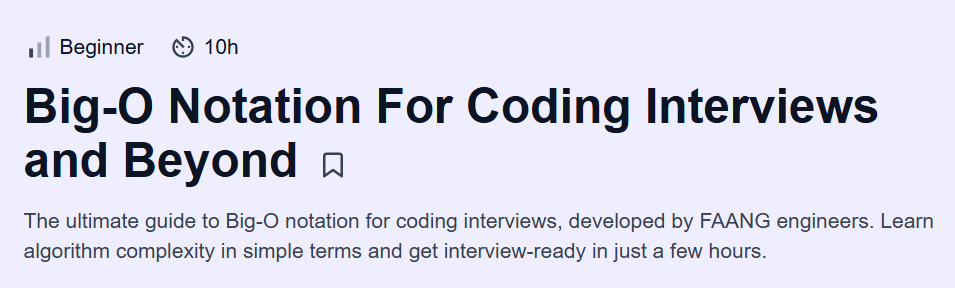
What will you learn in Big-O Notation For Coding Interviews and Beyond Course
-
Big‑O fundamentals in intuitive terms: Learn how to reason about runtime and space complexity without heavy math, perfect for developers lacking formal CS education.
-
Interview‑focused complexity analysis: Understand Big‑O, Big‑Omega, and Big‑Theta, and learn to explain analysis clearly during interviews.
-
Layman-friendly and practical explanations: Developed by FAANG engineers, this course breaks down complexity in conversational style with real-world examples and live code snippets.
-
Touchpoints on advanced complexity: Introduces advanced topics like amortized complexity and space trade-offs for a well-rounded perspective.
Program Overview
Module 1: Introduction to Big‑O
⏳ ~1 hour
-
Topics: What Big‑O means, why it matters, difference between worst, average, and best case.
-
Hands‑on: Interactive quizzes and live code snippets for analyzing common sequences.
Module 2: Time & Space Complexity
⏳ ~2 hours
-
Topics: Loop analysis, nested structures, memory usage, and function call overhead.
-
Hands‑on: Exercises to compute complexity for Python or Java code chunks.
Module 3: Complexity in Practice
⏳ ~2 hours
-
Topics: Real algorithms like sorting, search, and traversals—focusing on their Big‑O behavior.
-
Hands‑on: Analyze and compare implementations like quicksort, mergesort, and hash operations.
Module 4: Amortized & Advanced Analysis
⏳ ~1 hour
-
Topics: Amortized time (e.g., dynamic arrays), trade-offs, and quasi-linear concepts.
-
Hands‑on: Quizzes and practical examples for aggregate and real-world complexity.
Module 5: Interview Strategy & Explanation
⏳ ~30 minutes
-
Topics: Communicating complexity in interviews, using clear, structured reasoning.
-
Hands‑on: Practice mock explanations and code breakdowns.
Get certificate
Job Outlook
-
Core interview skill: Big‑O understanding is a non-negotiable for technical interviews, especially at top-tier firms.
-
Essential for scalable systems: Enables more efficient code and data structure choices in production environments.
-
Useful beyond theory: Provides language and rigor to discuss performance, bottlenecks, and system trade-offs.
-
Builds analytical confidence: Helps you make informed decisions—and defend them—during high-pressure technical discussions.