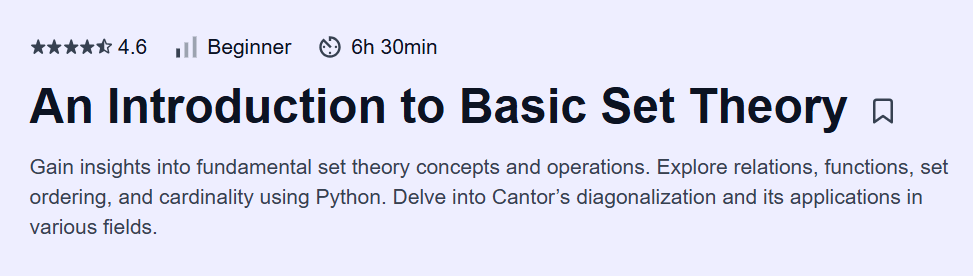
What will you learn in An Introduction to Basic Set Theory Course
-
Grasp foundational concepts: sets, subsets, power sets, and Cartesian products
-
Understand operations on sets: union, intersection, difference, and complement
-
Work with relations and functions: equivalence relations, injections, surjections, and bijections
-
Apply proofs techniques: induction, contradiction, and combinatorial arguments
-
Explore advanced topics: De Morgan’s laws, Venn diagrams, and the basics of cardinality
Program Overview
Module 1: Fundamentals of Sets
⏳ 1 week
-
Topics: Definitions, notation, roster vs. set‐builder forms
-
Hands-on: Create and classify sets; construct power sets for small finite examples
Module 2: Set Operations & Laws
⏳ 1 week
-
Topics: Union, intersection, difference, complement; associative, commutative, and distributive laws
-
Hands-on: Prove De Morgan’s laws and simplify set expressions with Venn diagrams
Module 3: Cartesian Products & Tuples
⏳ 1 week
-
Topics: Ordered pairs, n-tuples, product sets, and their sizes
-
Hands-on: Enumerate Cartesian products for given finite sets and count elements
Module 4: Relations on Sets
⏳ 1 week
-
Topics: Definitions of relations, domains, ranges, properties (reflexive, symmetric, transitive)
-
Hands-on: Determine whether sample relations are equivalence relations and partition sets accordingly
Module 5: Functions Between Sets
⏳ 1 week
-
Topics: Functions, injections, surjections, bijections, inverse functions, composition
-
Hands-on: Classify given mappings as injective/surjective/bijective and construct inverses
Module 6: Introduction to Proofs
⏳ 1 week
-
Topics: Direct proof, proof by contradiction, proof by induction in the context of sets
-
Hands-on: Prove basic set identities and use induction to establish formulas for cardinalities
Module 7: Cardinality & Infinite Sets
⏳ 1 week
-
Topics: Finite vs. infinite sets, countability, Cantor’s theorem on power sets
-
Hands-on: Show that the power set of ℕ has strictly greater cardinality than ℕ itself
Module 8: Applications & Advanced Patterns
⏳ 1 week
-
Topics: Inclusion–exclusion principle, Venn‐diagram problem solving, beginnings of combinatorial set theory
-
Hands-on: Solve counting problems using inclusion–exclusion and construct Venn diagrams for three sets
Get certificate
Job Outlook
- Set theory underpins computer science (data structures, databases), discrete mathematics, and formal logic
- Roles benefiting: Software Engineer, Data Scientist, Algorithm Designer, Research Analyst
- Salaries range broadly ($70,000–$140,000+) depending on specialization and industry
- A strong mathematical foundation opens doors to advanced studies in algorithms, cryptography, and AI
Explore More Learning Paths
Strengthen your mathematical reasoning and foundational skills with these related courses and resources. From engineering math to data science applications, these learning paths will help you build confidence in core mathematical concepts.
Related Courses
-
Mathematics for Engineers Specialization
Learn essential mathematical concepts and techniques applied in engineering and technical problem-solving. -
Introduction to Mathematical Thinking
Develop logical reasoning and problem-solving skills, preparing you for advanced mathematics and analytical tasks. -
Data Science Math Skills
Build the math foundation necessary for data science, including set theory, probability, and statistics for real-world applications.
Related Reading
-
What Is Python Used For
Understand how mathematical concepts like set theory are applied in Python programming and data science projects.