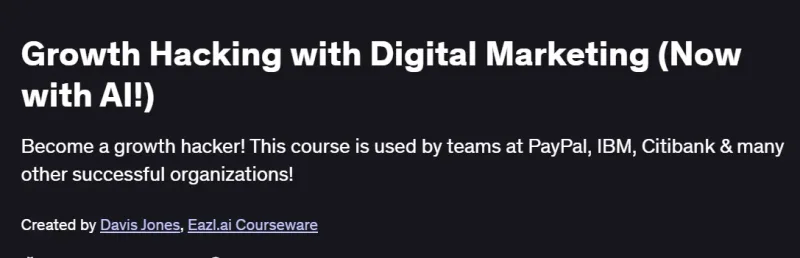
What will you in Growth Hacking with Digital Marketing (Now with AI!) Course
-
Identify high-impact growth channels and prioritize experiments using data-driven frameworks.
-
Conduct rapid audience research and leverage customer feedback loops for iterative product-market fit.
-
Design and execute acquisition, activation, retention, referral, and revenue (AARRR) strategies.
-
Utilize viral loops, incentive mechanics, and community building to amplify organic growth.
-
Implement low-budget paid acquisition tactics across Facebook Ads, Google Ads, and programmatic platforms.
-
Optimize conversion funnels with A/B testing, heatmaps, and analytics tools (Google Analytics, Mixpanel).
Program Overview
Module 1: Growth Hacking Mindset & Frameworks
⏳ 45 minutes
-
Define “growth hacker” vs. “marketer” and embrace cross-functional experimentation.
- Learn key frameworks: Pirate Metrics (AARRR), ICE scoring, and North Star metrics.
Module 2: Audience Research & Value Proposition
⏳ 1 hour
-
Conduct rapid surveys, interviews, and social listening to uncover pain points.
-
Craft and test value propositions with landing page prototypes and user feedback.
Module 3: Acquisition Channels & Tactics
⏳ 1 hour 15 minutes
-
Explore organic channels: SEO, content marketing, and influencer partnerships.
-
Launch paid tests: micro-budgets on Facebook, Google Search, and display networks.
Module 4: Activation & Onboarding Optimization
⏳ 45 minutes
-
Map user onboarding flows and identify drop-off points.
-
Use in-app messaging, tooltips, and email triggers to drive initial engagement.
Module 5: Retention & Engagement Strategies
⏳ 1 hour
-
Implement email drip campaigns, push notifications, and SMS reminders.
-
Leverage gamification, loyalty programs, and community forums to boost stickiness.
Module 6: Referral & Viral Growth Mechanics
⏳ 45 minutes
-
Design two-sided referral programs with compelling incentives.
-
Harness social sharing widgets, embed invites, and contest mechanics.
Module 7: Revenue Optimization & Monetization
⏳ 45 minutes
-
Test pricing tiers, free trials vs. freemium models, and upsell/cross-sell flows.
-
Analyze cohort LTV, CAC, and payback periods to inform financial decisions.
Module 8: Growth Automation & No-Code Tools
⏳ 45 minutes
-
Automate lead capture, nurturing, and re-engagement using Zapier, Integromat, and chatbots.
-
Build dashboards and alerts to monitor key KPIs in real time.
Module 9: Experimentation & Analytics
⏳ 1 hour
-
Set up A/B tests with platforms like Optimizely or Google Optimize.
-
Interpret statistical significance, analyze heatmaps, and iterate on findings.
Module 10: Scaling Growth Teams & Processes
⏳ 30 minutes
-
Establish growth OKRs, processes, and cross-functional sprints.
-
Recruit and structure growth teams: product, marketing, data, and engineering alignment.
Get certificate
Job Outlook
-
High-Demand Roles: Growth Hacker, Growth Marketing Manager, Product Growth Lead.
-
Salary Potential: ₹8–25 LPA in India; $90K–$140K annually in the U.S.
-
Growth Areas: SaaS, e-commerce, mobile apps, and D2C brands.
-
Career Impact: Mastery of growth hacking frameworks positions you to drive scalable user acquisition and retention in fast-moving startups and corporate innovation teams.
Explore More Learning Paths
Accelerate your digital marketing expertise with these curated programs designed to strengthen your growth strategies, enhance customer acquisition, and leverage AI to scale your marketing impact.
Related Courses
-
Generative AI for Digital Marketing Specialization Course – Learn how to apply AI tools to create personalized content, automate campaigns, and optimize marketing performance.
-
The Digital Marketing Revolution Course – Explore the modern marketing landscape and master the essential skills needed to thrive in today’s digital-first world.
-
Attract and Engage Customers with Digital Marketing Course – Build customer-centric marketing strategies to capture attention, drive engagement, and grow your audience effectively.
Related Reading
-
What Is Customer Relationship Management (CRM)? – Understand how CRM systems help businesses manage customer interactions and improve marketing outcomes.