
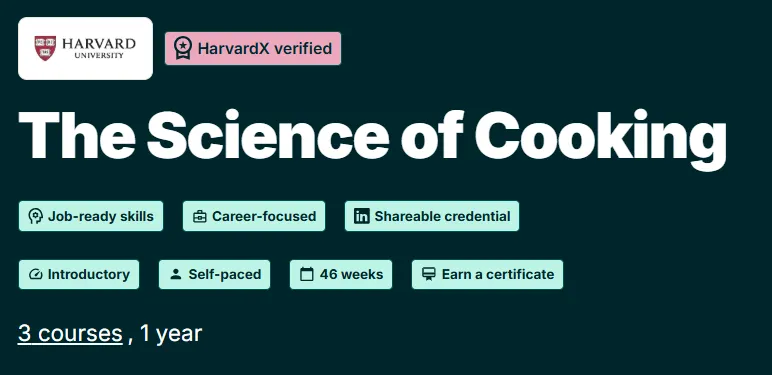
What will you learn in The Science of Cooking course
- This Professional Certificate explores the chemistry and physics behind everyday cooking processes.
- Learners will understand how heat, molecular interactions, and chemical reactions transform ingredients.
- The program emphasizes food structure, flavor development, emulsions, and texture formation.
- Students will explore the science behind baking, caramelization, fermentation, and molecular gastronomy.
- Real-world kitchen demonstrations connect scientific theory to culinary practice.
- By completing the certificate, participants gain a deeper understanding of cooking techniques grounded in scientific principles.
Program Overview
Heat, Energy, and Food Transformation
⏳ 4–6 Weeks
- Understand conduction, convection, and radiation.
- Explore protein denaturation and starch gelatinization.
- Analyze how temperature affects texture and flavor.
- Study water’s role in cooking processes.
Chemistry of Flavor and Texture
⏳ 4–6 Weeks
- Learn about Maillard reactions and caramelization.
- Understand emulsions and foams.
- Explore fat chemistry and flavor compounds.
- Analyze food structure at the molecular level.
Baking and Fermentation Science
⏳ 4–6 Weeks
- Study yeast fermentation and leavening.
- Understand gluten formation and dough elasticity.
- Explore sugar chemistry in desserts.
- Analyze acidity and pH effects in recipes.
Capstone Culinary Science Application
⏳ Final Weeks
- Apply scientific principles to recipe design.
- Experiment with ingredient substitutions.
- Analyze cooking techniques scientifically.
- Demonstrate mastery of food science fundamentals.
Get certificate
Job Outlook
- Knowledge of food science is valuable in culinary arts, food technology, product development, hospitality, and nutrition industries.
- Professionals with food science expertise are sought for roles such as Food Scientist, Culinary Innovation Specialist, Product Development Chef, and Quality Assurance Analyst.
- Entry-level food science professionals typically earn between $55K–$75K per year, while experienced food technologists and R&D managers can earn $90K–$130K+ depending on industry and region.
- Scientific cooking knowledge also benefits chefs, nutritionists, and culinary educators seeking deeper technical understanding.
- This certificate bridges culinary creativity with scientific precision