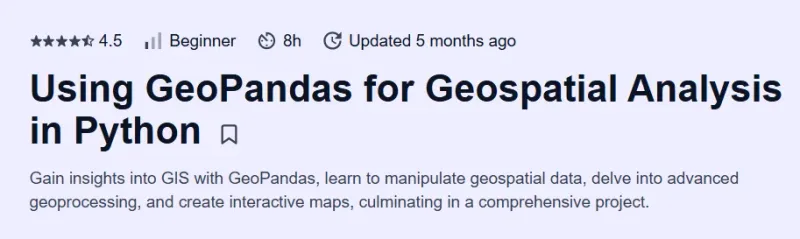
What will you learn in Using GeoPandas for Geospatial Analysis in Python Course
-
Understand core geospatial concepts and coordinate reference systems (CRS).
-
Read, write, and manipulate spatial data using GeoPandas.
-
Perform spatial joins, overlays, and queries to analyze geographic relationships.
-
Visualize geospatial datasets with built-in plotting and integration with Matplotlib.
-
Calculate metrics like area, distance, and buffering for spatial features.
Program Overview
Module 1: Introduction to GeoPandas & Geospatial Concepts
⏳ 1 hour
-
Topics: GIS fundamentals, CRS overview, installation and environment setup.
-
Hands-on: Load sample shapefiles and inspect geometries in a GeoDataFrame.
Module 2: Reading and Writing Spatial Data
⏳ 1.5 hours
-
Topics: Supported file formats, drivers, and file I/O methods.
-
Hands-on: Read GeoJSON and Shapefile data; write filtered results to new files.
Module 3: Geometric Operations
⏳ 2 hours
-
Topics: Buffering, intersection, union, and difference operations on geometries.
-
Hands-on: Compute buffers around point features and intersect polygons for analysis.
Module 4: Spatial Joins and Overlays
⏳ 2 hours
-
Topics: Spatial indexing, join types, overlay methods (union, intersection).
-
Hands-on: Join point data to polygon boundaries and summarize attributes by region.
Module 5: Attribute and Query Operations
⏳ 1.5 hours
-
Topics: Filtering by attributes, spatial queries, custom predicate functions.
-
Hands-on: Query features within a certain distance and filter by attribute values.
Module 6: Visualization of Geospatial Data
⏳ 1.5 hours
-
Topics: Thematic mapping, choropleth plots, Matplotlib integration, legends.
-
Hands-on: Create maps showing population density and land-use classifications.
Module 7: Advanced Analysis & Metrics
⏳ 1.5 hours
-
Topics: Calculating area, length, centroids, and reprojection techniques.
-
Hands-on: Reproject datasets to a common CRS and compute feature areas in km².
Get certificate
Job Outlook
-
Geospatial analysts and GIS developers are in high demand across urban planning, environmental consultancies, logistics, and government.
-
Roles include GIS Analyst, Geospatial Data Scientist, and Location Intelligence Specialist, with salaries typically ranging from $70K–$110K USD.
-
Proficiency in Python-based geospatial tools enhances opportunities in mapping startups, conservation projects, and smart-city initiatives.
Explore More Learning Paths
Expand your Python and geospatial analysis expertise with these carefully selected courses designed to strengthen your programming foundation and help you work with spatial data effectively.
Related Courses
-
Introduction to Python Course – Build a strong Python foundation to support geospatial data analysis and automation.
-
Crash Course on Python Course – Quickly learn Python essentials and gain practical coding skills for handling geospatial datasets.
-
Python Basics Course – Master core Python concepts, data types, and functions needed for effective geospatial programming.
Related Reading
-
What Is Python Used For – Discover how Python is applied in data science, geospatial analysis, and other modern technology fields.