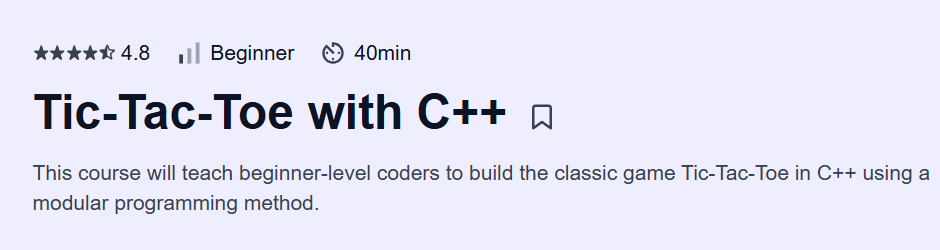
What will you learn in Tic-Tac-Toe with C++ Course
-
Implement a complete Tic-Tac-Toe game in C++, mastering game loops, input handling, and board representation
-
Apply fundamental C++ concepts: functions, arrays/vectors, control flow, and basic object-oriented design
-
Develop a computer opponent using the Minimax algorithm for unbeatable gameplay
-
Handle game state validation, win/draw detection, and replay logic with robust error checking
-
Structure and modularize code for maintainability, and test game components with simple unit tests
Program Overview
Module 1: Project Setup & C++ Refresher
⏳ 15 minutes
-
Topics: Setting up your C++ project (compiler, IDE), basic syntax review,
main()structure -
Hands-on: Write a “Hello, Tic-Tac-Toe” stub and verify compilation/execution
Module 2: Board Representation & Display
⏳ 20 minutes
-
Topics: Using arrays or
std::vectorto model a 3×3 grid, printing the board to console -
Hands-on: Implement and test a function to render the game board after each move
Module 3: Player Input & Turn Management
⏳ 20 minutes
-
Topics: Reading user input safely, validating moves, alternating player turns
-
Hands-on: Build input routines that reject invalid coordinates and place marks on the board
Module 4: Win/Draw Detection
⏳ 25 minutes
-
Topics: Checking rows, columns, and diagonals for a win, detecting full-board draw state
-
Hands-on: Implement and unit-test functions that return game-over status
Module 5: Introducing the Computer Opponent
⏳ 30 minutes
-
Topics: Basic AI concepts, game trees, and the Minimax algorithm overview
-
Hands-on: Code a recursive Minimax function to evaluate board states and choose optimal moves
Module 6: Integrating AI & Game Loop
⏳ 20 minutes
-
Topics: Merging human and AI turns into a continuous game loop, delay and output cues
-
Hands-on: Finalize
whileloop that alternates human and AI until game-over, then prompt replay
Module 7: Code Organization & Testing
⏳ 15 minutes
-
Topics: Modularizing code into functions/classes, writing simple assertion-based tests
-
Hands-on: Refactor your code into header/source files and add test cases for core functions
Module 8: Conclusion & Next Steps
⏳ 10 minutes
-
Topics: Recap key concepts, suggestions for enhancements (GUI, network play, alternative AI heuristics)
-
Hands-on: Plan at least two feature enhancements to extend your Tic-Tac-Toe project
Get certificate
Job Outlook
-
Junior C++ Developer: $75,000–$100,000/year — apply foundational C++ skills to real-world applications
-
Game Developer (Entry-Level): $60,000–$85,000/year — use game-logic implementations like Tic-Tac-Toe to demonstrate problem-solving
-
Software Engineer Intern: $50,000–$70,000/year — showcase algorithmic and code-organization skills in interviews
-
Mastery of core C++ constructs, game loops, and basic AI algorithms accelerates readiness for technical coding interviews and more complex system development.
Explore More Learning Paths
Enhance your C++ programming and problem-solving skills with these hand-picked programs designed to strengthen your coding fundamentals and build practical, real-world applications.
Related Courses
-
Mini-Course: Build Rock, Paper, Scissors with C++ Course – Practice C++ fundamentals by creating interactive console games and understanding core programming logic.
-
C17 in Detail: A Deep Dive Course – Explore advanced features of modern C++ (C17), including syntax updates, memory management, and best practices.
-
Object-Oriented Data Structures in C++ Course – Strengthen your understanding of data structures and OOP concepts to design efficient and scalable C++ applications.
Related Reading
Gain deeper insight into how structured knowledge improves software development:
-
What Is Knowledge Management? – Learn how organizing and applying programming knowledge can enhance coding efficiency, collaboration, and project outcomes.