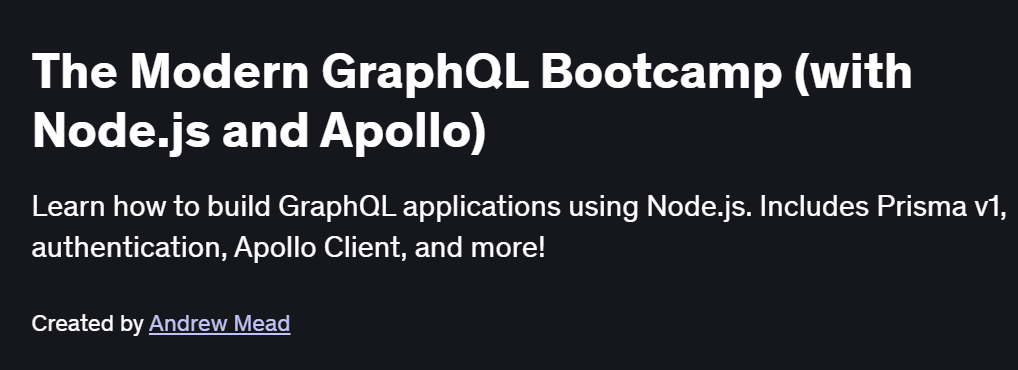
What will you in The Modern GraphQL Bootcamp (with Node.js and Apollo) Course
- Design GraphQL schemas with types, queries, mutations, and subscriptions
- Implement a GraphQL server using Node.js, Apollo Server, or similar frameworks
- Query and manipulate data from multiple data sources (REST, databases) via resolvers
- Integrate GraphQL with front-end clients (Apollo Client, Relay) for efficient data fetching
- Implement real-time updates with GraphQL subscriptions over WebSockets
- Apply authentication, authorization, and performance best practices in GraphQL APIs
Program Overview
Module 1: GraphQL Fundamentals & Schema Design
⏳ 45 minutes
-
Understanding the GraphQL type system, schema language, and entry points
-
Defining object types, scalar types, enums, and input types
Module 2: Setting Up Your GraphQL Server
⏳ 1 hour
-
Installing Apollo Server (or alternative), writing your first
typeDefsandresolvers -
Connecting to a database (MongoDB/PostgreSQL) and wiring up resolver logic
Module 3: Queries & Mutations
⏳ 1 hour
-
Writing complex queries with arguments, aliases, and fragments
-
Implementing create/update/delete operations via mutations and input validation
Module 4: Apollo Client & Front-End Integration
⏳ 1 hour
-
Configuring Apollo Client in React or Vue, executing queries and mutations
-
State management with the Apollo cache and
useQuery/useMutationhooks
Module 5: Real-Time with Subscriptions
⏳ 45 minutes
-
Setting up WebSocket link, defining subscription types in the schema
-
Consuming live data updates in the front end
Module 6: Advanced Schema Design & Tooling
⏳ 1 hour
-
Schema stitching and federation for microservice architectures
-
Using GraphQL SDL-first vs. code-first approaches and schema introspection
Module 7: Security, Performance & Monitoring
⏳ 45 minutes
-
Implementing authentication (JWT, OAuth) and fine-grained field-level authorization
-
Query complexity analysis, depth limiting, and persisted queries
Module 8: Testing, Deployment & Best Practices
⏳ 45 minutes
-
Writing unit and integration tests for resolvers using Jest and Apollo Server testing tools
-
Deploying to Node-hosted environments (Heroku, AWS Lambda) and CI/CD integration
Get certificate
Job Outlook
- GraphQL expertise is increasingly sought for roles like Full-Stack Developer, API Engineer, and Front-End Engineer
- Enables building efficient, flexible APIs for web and mobile applications across industries
- Prepares you for working in modern stacks (Apollo, Relay, Hasura) and contributes to microservice architectures
- Lays the groundwork for advanced API topics: schema federation, GraphQL on the edge, and enterprise-grade tooling
Explore More Learning Paths
Expand your GraphQL and backend development expertise with these carefully curated courses designed to help you build efficient APIs and modern web applications.
Related Courses
-
Building a GraphQL Endpoint with Deno Course – Learn to create fast and secure GraphQL endpoints using Deno for modern web development.
Related Reading
-
What Is Data Management? – Understand how proper data management supports the design and operation of reliable APIs.