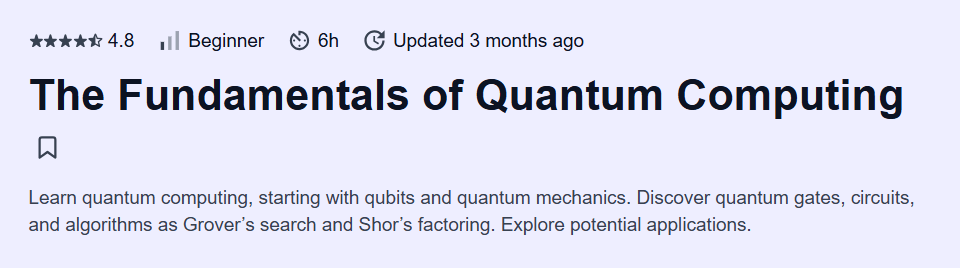
What will you learn in The Fundamentals of Quantum Computing Course
- Understand the principles of quantum mechanics that power quantum computing.
- Explore core concepts like superposition, entanglement, and qubits.
- Learn about quantum gates, circuits, and quantum measurement.
- Work with Bloch spheres, unitary matrices, and the mathematics behind quantum algorithms.
- Discover quantum algorithms such as Grover’s and Shor’s, and their applications.
- Build a foundation to advance into quantum programming with tools like Qiskit.
Program Overview
Module 1: Introduction to Quantum Computing
⏳ 1.5 hours
-
Topics: What is quantum computing, classical vs. quantum, real-world use cases.
-
Hands-on: Conceptual visualizations of qubit behavior and quantum hardware.
Module 2: Qubits and Superposition
⏳ 2 hours
-
Topics: Qubits vs. bits, quantum states, Dirac notation, superposition.
-
Hands-on: Simulate simple qubit states and interpret amplitudes.
Module 3: Quantum Gates and Circuits
⏳ 2.5 hours
-
Topics: Pauli gates, Hadamard, CNOT, unitary operations, quantum logic.
-
Hands-on: Build simple quantum circuits and evaluate output states.
Module 4: Quantum Measurement
⏳ 1.5 hours
-
Topics: Collapse of the wavefunction, probability amplitudes, measuring qubits.
-
Hands-on: Measure quantum states and observe changes over time.
Module 5: Entanglement and Multi-Qubit Systems
⏳ 2 hours
-
Topics: Bell states, EPR paradox, quantum teleportation basics.
-
Hands-on: Construct and test entangled qubit systems.
Module 6: Quantum Algorithms Overview
⏳ 2.5 hours
-
Topics: Grover’s algorithm, Shor’s algorithm, quantum search and factoring.
-
Hands-on: Simulate small-scale algorithms with step-by-step walkthroughs.
Module 7: Real-World Quantum Applications
⏳ 2 hours
-
Topics: Cryptography, optimization, quantum machine learning.
-
Hands-on: Explore simplified applications and implementation strategies.
Get certificate
Job Outlook
-
Quantum computing is an emerging field with growing opportunities in research, defense, cryptography, and AI.
-
Skills in quantum mechanics and algorithm design are in high demand for roles like quantum developer, research scientist, and algorithm engineer.
-
Companies like IBM, Google, and Microsoft are investing heavily in quantum R&D.
-
Early adopters of quantum skills can expect long-term benefits in tech, academia, and finance.
Explore More Learning Paths
Expand your knowledge of quantum computing with this carefully selected program designed to help you understand the principles of quantum mechanics and their applications in computing.
Related Courses
-
Introduction to Quantum Information Course – Learn the foundational concepts of quantum information, qubits, and quantum algorithms to prepare for advanced quantum computing studies.
Related Reading
-
What Is Python Used For – Explore how Python plays a key role in implementing and simulating quantum algorithms and other modern computing applications.