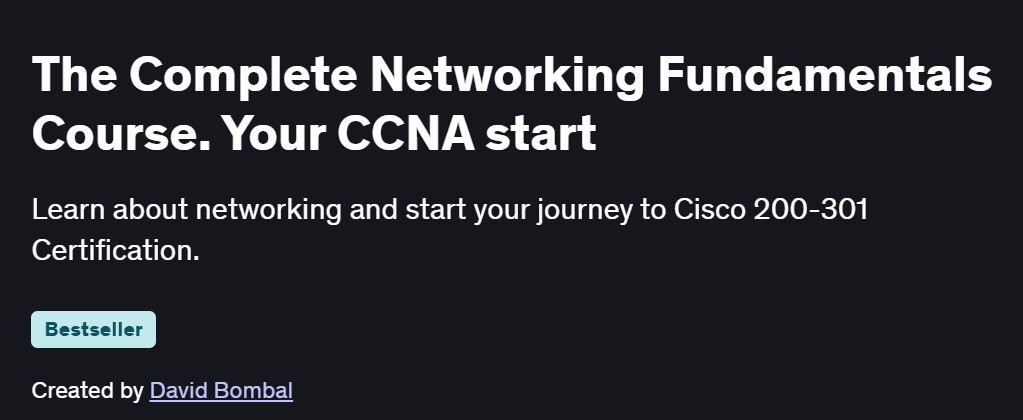
What will you in The Complete Networking Fundamentals Course. Your CCNA start Course
-
Understand networking basics including IP addressing, subnetting, and protocols
-
Learn how data travels across networks and the OSI model structure
-
Gain foundational knowledge for configuring routers, switches, and firewalls
-
Build practical skills with real-world labs and Cisco Packet Tracer
-
Prepare for entry-level networking roles and future CCNA certification
Program Overview
Introduction to Networking
⏳ 45 minutes
-
What is a network? Types of networks and topologies
-
OSI and TCP/IP models explained in simple terms
IP Addressing and Subnetting
⏳ 1 hour
-
IPv4 addressing, subnet masks, and default gateways
-
CIDR notation, subnetting calculations, and practice exercises
Switches, Routers & Firewalls
⏳ 1 hour
-
Functions and roles of routers, switches, and firewalls
-
Basic configuration using Cisco CLI and Packet Tracer
Cabling, Devices & Packet Flow
⏳ 45 minutes
-
Ethernet standards, straight-through vs crossover cables
-
MAC addresses, ARP, and how packets move across networks
Wireless, NAT, and DHCP
⏳ 45 minutes
-
Introduction to wireless networking and encryption types
-
NAT, DHCP, DNS – core services in modern networks
Real-World Labs & Simulations
⏳ 1 hour
-
Cisco Packet Tracer setup and configuration labs
-
Step-by-step simulations of common networking scenarios
Certification & Career Path Guidance
⏳ 30 minutes
-
Introduction to the CCNA path and what’s next after this course
-
Career options and tips to start a networking career
Get certificate
Job Outlook
-
Networking is the backbone of IT infrastructure, and demand for skilled professionals is growing
-
Common roles include Network Technician, Support Engineer, and IT Administrator
-
Entry-level certifications like CCNA open doors to advanced careers in cybersecurity and cloud
-
Strong job prospects in enterprises, telecom, MSPs, and remote freelancing
Explore More Learning Paths
Strengthen your networking expertise with curated programs that build a solid foundation in network design, cloud networking, and practical CCNA skills.
Related Courses
-
Networking in Google Cloud: Routing and Addressing Course – Learn core networking concepts in a cloud environment, including IP addressing, routing, and subnetting.
-
Google Cloud IAM and Networking for AWS Professionals Course – Transition your cloud networking knowledge from AWS to GCP, focusing on identity, access, and network configuration.
-
Networking in Google Cloud Fundamentals Course – Build foundational networking skills for cloud infrastructure, including VPCs, firewalls, and connectivity strategies.
Related Reading
Enhance your structured approach to managing network systems:
-
What Is Data Management? – Discover how effective data organization and handling improve network performance and IT operations.