9.5/10
Highly Recommended
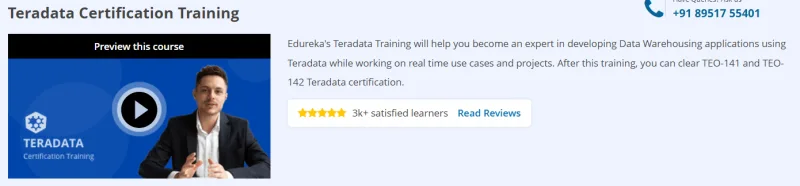
Teradata Certification Training Course on Edureka — A thorough and hands-on Teradata training program that balances core architecture, advanced SQL, and performance tuning for production environments.
Pros
- Deep dive into both foundational architecture and advanced utilities
- Real-world labs on loading, tuning, and high-availability setups
- Capstone mimics enterprise data warehouse lifecycle
Cons
- Assumes familiarity with SQL and database concepts
- Limited coverage of cloud-native Teradata Vantage offerings
Teradata Certification Training Course Course
Platform: Edureka
Instructor: Unknown
What will you learn in Teradata Certification Training Course
-
Understand Teradata’s MPP architecture, node operations, and data distribution
-
Master Teradata SQL extensions: primary index, secondary index, join indexes, and partitioning
-
Perform data loading and extraction using FastLoad, MultiLoad, and TPT utilities
-
Optimize query performance with statistics collection, explain plans, and workload management
-
Implement backup, recovery, and security best practices for enterprise data warehouses
Program Overview
Module 1: Introduction to Teradata & Architecture
⏳ 1 week
-
Topics: Teradata ecosystem, AMP functionality, parsing, PT and BYNET layers
-
Hands-on: Explore a multi-node Teradata setup and run basic diagnostic scripts
Module 2: Teradata SQL & Data Modeling
⏳ 1 week
-
Topics: Primary and secondary index design, normalized vs. denormalized models, partitioned primary index
-
Hands-on: Create tables with various index types and analyze data distribution
Module 3: Data Loading & Unloading Utilities
⏳ 1 week
-
Topics: FastLoad, MultiLoad, TPT (Teradata Parallel Transporter), BTEQ basics
-
Hands-on: Load large datasets into Teradata using FastLoad and extract with MultiLoad
Module 4: Query Tuning & Performance Optimization
⏳ 1 week
-
Topics: Collecting statistics, explain plan analysis, optimizer directives, join strategies
-
Hands-on: Tune slow-running queries using statistics and alternative join techniques
Module 5: Advanced SQL & Scripting
⏳ 1 week
-
Topics: Macros, stored procedures, user-defined functions, recursive queries
-
Hands-on: Develop a stored procedure to implement business rules and recursive data retrieval
Module 6: Workload Management & Security
⏳ 1 week
-
Topics: Teradata Viewpoint, resource limits, user profiles, roles, and privileges
-
Hands-on: Configure load throttles and implement row-level security policies
Module 7: Backup, Recovery & High Availability
⏳ 1 week
-
Topics: ARC utility, TDP backup, failover strategies, disaster recovery planning
-
Hands-on: Perform a full and incremental backup and simulate node failure recovery
Module 8: Capstone Project
⏳ 1 week
-
Topics: End-to-end data warehousing solution design with ETL, modeling, and tuning
-
Hands-on: Build a sample retail data warehouse pipeline, optimize queries, and present performance metrics
Job Outlook
-
Teradata expertise is critical for large-scale data warehousing roles in finance, telecom, retail, and healthcare
-
Roles include Teradata Developer, Data Warehouse Architect, and ETL Engineer
-
Salaries range from $100,000 to $160,000+ based on experience and region
-
Organizations rely on Teradata for mission-critical analytics, driving sustained demand
FAQs
Do I need prior database or SQL experience to take this course?
No prior experience is required; the course is suitable for beginners and IT professionals. It introduces Teradata architecture, SQL basics, and database concepts step by step. Learners practice querying, manipulating, and analyzing data in Teradata. Basic familiarity with computers and logical thinking is helpful but not mandatory. By the end, learners can confidently use Teradata for database management and analytics.
Will I learn Teradata SQL and query optimization techniques?
Yes, the course covers Teradata SQL for data retrieval, manipulation, and reporting. Learners practice writing queries, joins, subqueries, and aggregations. Techniques include using functions, views, and indexing for efficient database performance. Hands-on exercises demonstrate practical query optimization and problem-solving. Advanced optimization for large-scale data may require additional practice.
Can I use this course to prepare for Teradata certification exams?
Yes, the course is designed to help learners prepare for official Teradata certification exams. Learners practice exam-oriented concepts, sample questions, and scenario-based exercises. Techniques include mastering SQL commands, Teradata architecture, and database design principles. Hands-on exercises simulate real-world exam scenarios for better preparation. Passing the exam validates professional competency in Teradata database management.
Will I learn how to manage and analyze large datasets in Teradata?
Yes, the course teaches handling, storing, and analyzing large volumes of data. Learners practice using Teradata tools for ETL, data warehousing, and analytics. Techniques include partitioning, indexing, and aggregating data efficiently. Hands-on exercises help learners manage real-world datasets and derive insights. Advanced analytics techniques may require additional study or practical experience.
Can I use this course to advance my career in data analytics or database management?
Yes, Teradata certification enhances career prospects in database administration and data analytics. Learners can work with corporate databases, ETL processes, and analytics projects. Hands-on exercises provide practical examples to showcase Teradata proficiency. Certification helps learners stand out for job roles, promotions, or freelance opportunities. Advanced career growth may require additional certifications or experience.