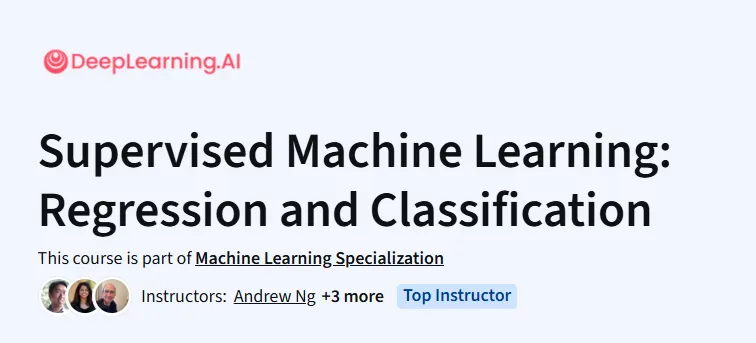
What will you learn in Supervised Machine Learning: Regression and Classification Course
-
Understand key machine learning concepts: supervised vs. unsupervised learning, bias–variance trade-off, and model evaluation.
-
Implement algorithms such as linear regression, logistic regression, neural networks, support vector machines, and clustering.
-
Apply best practices for training, tuning, and deploying models, including regularization, cross-validation, and feature selection.
-
Gain practical experience coding ML algorithms from scratch and using Octave/MATLAB to solidify understanding.
-
Develop intuition for when and how to apply different ML techniques to real-world problems.
Program Overview
Week 1: Introduction & Linear Regression with One Variable
⏳ 3 hours
-
Topics: Course logistics, data representations, linear regression algorithm, cost function, gradient descent.
-
Hands-on: Implement linear regression in Octave; explore feature scaling and convergence.
Week 2: Linear Regression with Multiple Variables
⏳ 4 hours
-
Topics: Multivariate linear regression, normal equation, polynomial regression, feature normalization.
-
Hands-on: Compare gradient descent and normal equation approaches on housing price datasets.
Week 3: Logistic Regression & Regularization
⏳ 4 hours
-
Topics: Classification with logistic regression, decision boundaries, cost function adaptation, regularization to prevent overfitting.
-
Hands-on: Build a spam classifier; tune regularization parameter and visualize decision regions.
Week 4: Neural Networks: Representation
⏳ 3 hours
-
Topics: Biological vs. artificial neurons, network architectures, forward propagation, activation functions.
-
Hands-on: Implement feedforward propagation for a two-layer neural network.
Week 5: Neural Networks: Learning
⏳ 4 hours
-
Topics: Backpropagation algorithm, gradient checking, random initialization, hyperparameter tuning.
-
Hands-on: Train a neural network for handwritten digit recognition (MNIST); experiment with hidden layer sizes.
Week 6: Advice for Applying Machine Learning & Support Vector Machines
⏳ 5 hours
-
Topics: Error analysis, bias–variance trade-off, train/validation/test splits, support vector machines (SVMs), kernels.
-
Hands-on: Implement SVM classifier with Gaussian kernels for non-linear classification tasks.
Week 7: Unsupervised Learning & Anomaly Detection
⏳ 3 hours
-
Topics: K-means clustering, dimensionality reduction with PCA, anomaly detection using Gaussian models.
-
Hands-on: Cluster data with K-means; apply PCA for visualization; detect anomalies in network traffic logs.
Week 8: Recommender Systems & Large-Scale ML
⏳ 3 hours
-
Topics: Collaborative filtering, low-rank matrix factorization, stochastic gradient descent, MapReduce overview.
-
Hands-on: Build a basic movie recommendation engine; discuss scaling ML with distributed computing.
Get certificate
Job Outlook
-
Roles: Machine Learning Engineer, Data Scientist, Research Scientist, AI Specialist.
-
Demand: Strong across tech, finance, healthcare, and e-commerce, with companies seeking practitioners who can bridge theory and application.
-
Salaries: Entry-level positions typically start at $90K–$120K; experienced ML engineers earn $130K–$180K+.
-
Growth: Mastery of core ML algorithms and best practices opens doors to advanced roles in AI research, product development, and leadership.
Explore More Learning Paths
Expand your machine learning expertise with these carefully selected courses designed to strengthen your skills in both supervised and unsupervised learning techniques.
Related Courses
-
Applied Machine Learning in Python Course – Apply supervised machine learning techniques in Python, covering regression, classification, and model evaluation with hands-on projects.
-
Unsupervised Learning, Recommenders & Reinforcement Learning Course – Learn advanced machine learning concepts including unsupervised methods, recommendation systems, and reinforcement learning.
-
Cluster Analysis and Unsupervised Machine Learning in Python Course – Gain practical experience with clustering techniques and unsupervised learning algorithms in Python.
Related Reading
Gain deeper insight into the roles driving machine learning innovation:
-
What Is a Data Scientist? – Understand the responsibilities, skills, and career opportunities for data scientists working with machine learning models and analytics.