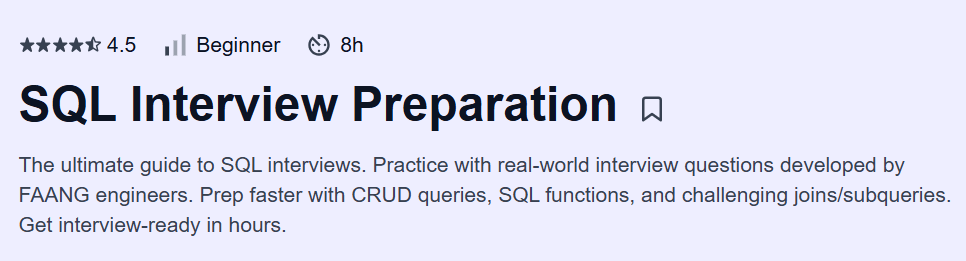
What will you learn in SQL Interview Preparation Course
-
Intermediate to advanced SQL concepts: Gain mastery in database creation, views, indexing, stored procedures, and complex query constructs.
-
Function and operator fluency: Deep dive into aggregate, date/time, string functions, regular expressions, CASE statements, and set operators (UNION, INTERSECT).
-
Window and analytic functions: Learn ranking functions (LAG, LEAD, RANK, FIRST_VALUE) and window aggregates critical for analytics interviews.
-
Subqueries, joins & performance: Tackle nested queries, advanced JOIN patterns including CROSS JOINs, and optimize through schema and indexing best practices.
Program Overview
Module 1: Get Started & CRUD Basics
⏳ ~30 minutes
-
Topics: Database creation, deletion, cascading operations, and basic insert/update/delete SQL statements.
-
Hands-on: Practice through quizzes and write SQL to manipulate tables.
Module 2: Views
⏳ ~30 minutes
-
Topics: Creating and using views, including those with aggregate results.
-
Hands-on: Define and query views with interactive exercises.
Module 3: Indexes
⏳ ~30 minutes
-
Topics: Single and composite index creation and signal how indexing improves query speed.
-
Hands-on: Write index creation statements and test query optimizations.
Module 4: Stored Procedures
⏳ ~1 hour
-
Topics: Building parameterized stored procedures to handle inserts, updates, and deletions.
-
Hands-on: Compose and run robust stored procedures.
Module 5: Complex Data Handling
⏳ ~1 hour
-
Topics: String manipulation, REGEX queries, CASE usage, and CROSS JOIN patterns.
-
Hands-on: Quiz-style challenges for advanced expression handling.
Module 6: Set Operators
⏳ ~30 minutes
-
Topics: Applying UNION, UNION ALL, INTERSECT in multi-table analytical contexts.
-
Hands-on: Combine datasets across tables in example queries.
Module 7: Ranking & Analytic Functions
⏳ ~1 hour
-
Topics: Learn LAG, LEAD, RANK, FIRST_VALUE/LAST_VALUE/NTH_VALUE for advanced analytics.
-
Hands-on: Write SQL to derive reports such as top-performers and trend analysis.
Module 8: Subqueries & Final Tips
⏳ ~30 minutes
-
Topics: Nested subqueries with aggregation, filtering patterns, HAVING clausa.
-
Hands-on: Build multi-layer queries via coding pads and end-of-course mock interview session.
Get certificate
Job Outlook
-
SQL interview readiness: Designed for intermediate to senior database engineers, analysts, and backend developers preparing for FAANG-level interviews.
-
Data-driven roles: Supports careers in analytics, BI, data warehousing, and full-stack backend development.
-
Production-grade queries: Teaches scalable query patterns and indexing—critical for performance tuning roles.
-
Certification edge: Certificate serves as micro-credential for LinkedIn and resume enhancement.
Explore More Learning Paths
Strengthen your SQL and database skills with these carefully selected programs designed to prepare you for data-driven roles and technical interviews.
Related Courses
-
Databases and SQL for Data Science with Python Course – Learn SQL fundamentals and how to interact with databases using Python for data analysis.
-
BI Foundations with SQL, ETL, and Data Warehousing Specialization Course – Master SQL, ETL processes, and data warehousing concepts to prepare for business intelligence roles.
-
Database Design and Basic SQL in PostgreSQL – Gain practical skills in database design and PostgreSQL SQL commands, ideal for interview readiness.
Related Reading
-
What Is Data Management? – Learn how proper data management practices support efficient querying, analysis, and database organization.