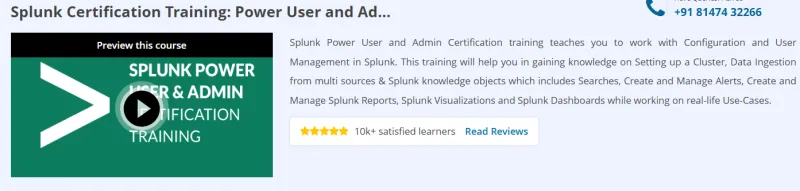
What will you learn in Splunk Certification Training: Power User and Admin Course
-
Navigate Splunk’s architecture: forwarders, indexers, search heads, and deployment servers
-
Ingest, parse, and index machine data from diverse sources (logs, metrics, network traffic)
-
Craft powerful SPL (Search Processing Language) queries for ad hoc searches, statistical analysis, and visualizations
-
Build dashboards, reports, and alerts to monitor infrastructure, security, and application performance
-
Implement role-based access control, data retention policies, and best practices for scaling Splunk deployments
-
Integrate Splunk with external systems via REST APIs and develop custom Splunk apps
Program Overview
Module 1: Introduction to Splunk & Architecture
⏳ 1 week
-
Topics: Splunk components, data flow, licensing models, and deployment topologies
-
Hands-on: Install Splunk Enterprise, configure a universal forwarder, and verify data ingestion
Module 2: Data Onboarding & Field Extraction
⏳ 1 week
-
Topics: Source types, inputs.conf/transforms.conf, props.conf, and automated vs. manual field extractions
-
Hands-on: Ingest syslog, web server logs, and JSON data; create regex and Delimiter-based field extractions
Module 3: Search Fundamentals & SPL
⏳ 1 week
-
Topics: Core search commands (
search,stats,timechart), subsearches, event vs. transaction searches -
Hands-on: Write searches to compute metrics (e.g., top URLs, error rates) and transform results
Module 4: Advanced SPL & Reporting
⏳ 1 week
-
Topics:
eval,rex,join,mvexpand, lookups, and workflow actions -
Hands-on: Enrich data with CSV lookups, create calculated fields, and build ad hoc reports
Module 5: Dashboards & Visualizations
⏳ 1 week
-
Topics: Simple XML dashboards, panels, tokens, drilldowns, and advanced visualizations (charts/maps)
-
Hands-on: Design a service-monitoring dashboard with panels for latency, error rate, and capacity alerts
Module 6: Alerts & Scheduled Searches
⏳ 1 week
-
Topics: Alert types (real-time vs. scheduled), throttling, trigger actions (email, webhook, script)
-
Hands-on: Configure alerts for threshold breaches and automate incident creation via webhook integration
Module 7: Splunk Administration & Best Practices
⏳ 1 week
-
Topics: User roles/capabilities, index management, retention settings, clustering, and performance tuning
-
Hands-on: Set up indexer clustering, configure replication, and optimize search head performance
Module 8: Splunk Apps & Extensibility
⏳ 1 week
-
Topics: Installing and configuring Splunkbase apps, building custom apps, REST API usage, SDKs
-
Hands-on: Install the Splunk App for Windows Infrastructure and develop a simple custom app
Get certificate
Job Outlook
-
Splunk Administrator / Engineer: $90,000–$130,000/year — design and maintain Splunk infrastructure and searches
-
Security Analyst (SIEM Specialist): $95,000–$140,000/year — leverage Splunk for security monitoring and incident response
-
DevOps / Site Reliability Engineer: $100,000–$150,000/year — integrate Splunk for observability, alerting, and automated remediation
-
Splunk expertise is in high demand across finance, healthcare, retail, and government sectors for operational intelligence and security.
Explore More Learning Paths
Boost your data analytics and operational intelligence skills with these hand-picked programs designed to expand your Splunk expertise and accelerate your career in IT operations and security.
Related Courses
-
Splunk Beginner to Architect Course – Learn end-to-end Splunk skills, from basic searches and dashboards to advanced data ingestion, administration, and architecture best practices.
Related Reading
Gain deeper insight into how structured data management supports business intelligence:
-
What Is Data Management? – Explore the practices that ensure organizational data is accurate, accessible, and actionable for analytics and decision-making.