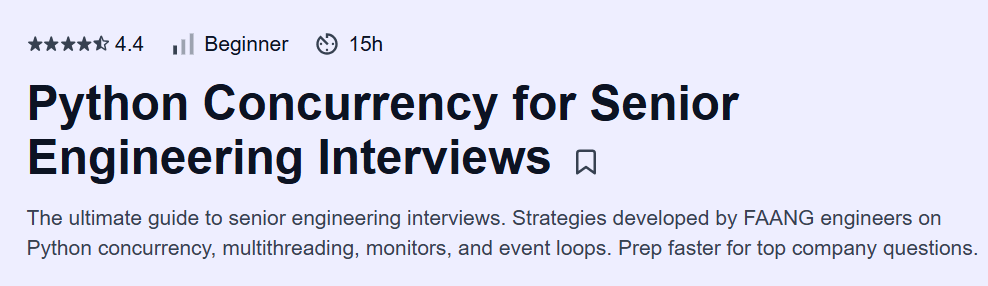
What will you learn in Python Concurrency for Senior Engineering Interviews Course
-
Master concurrency fundamentals in Python including threads, processes, async/await, and coroutines
-
Understand Python’s Global Interpreter Lock (GIL) and how it impacts multi-threaded performance
-
Implement thread-safe code using locks, semaphores, queues, and condition variables
-
Write high-performance concurrent programs using
asyncioand asynchronous I/O -
Solve real-world interview-style problems involving multithreading and parallel processing
-
Prepare for senior engineering interviews by practicing concurrency scenarios, code challenges, and design discussions
Program Overview
Module 1: Introduction to Concurrency
⏳ 45 minutes
-
Topics: Concurrency vs. parallelism, CPU-bound vs. I/O-bound tasks, context switching
-
Hands-on: Compare execution times for concurrent vs. sequential function calls
Module 2: Multithreading in Python
⏳ 1.5 hours
-
Topics: Thread creation, joining, and daemon threads; thread lifecycle
-
Hands-on: Build a multithreaded downloader and use
threading.Threadfor parallel execution
Module 3: Synchronization Primitives
⏳ 2 hours
-
Topics: Locks, RLocks, Semaphores, Conditions, Events
-
Hands-on: Implement a producer-consumer queue, reader-writer lock, and race condition avoidance
Module 4: Multiprocessing & the GIL
⏳ 2 hours
-
Topics: The Global Interpreter Lock, multiprocessing module, process pools
-
Hands-on: Build a CPU-bound app using multiprocessing to bypass the GIL limitations
Module 5: Asynchronous Programming with asyncio
⏳ 2 hours
-
Topics: Event loops, coroutines, tasks, futures,
await,async -
Hands-on: Use
asyncioto write an asynchronous web scraper and simulate parallel API calls
Module 6: Advanced Concurrency Patterns
⏳ 1.5 hours
-
Topics: Pipelines, fan-in/fan-out, task cancellation, deadlock prevention
-
Hands-on: Design and implement a multi-stage data pipeline using asyncio and queues
Module 7: Concurrency Interview Challenges
⏳ 2.5 hours
-
Topics: Classic interview questions (e.g., dining philosophers, bounded buffer, thread-safe counter)
-
Hands-on: Solve concurrency-specific questions with detailed step-by-step solutions
Get certificate
Job Outlook
-
Senior Python Engineers with concurrency experience earn between $130,000–$180,000/year in the U.S.
-
High demand in industries like finance, real-time systems, cloud services, and backend engineering
-
Roles include Backend Developer, Distributed Systems Engineer, Performance Engineer, and SRE
-
Concurrency knowledge is essential for designing scalable, low-latency applications in production environments
Explore More Learning Paths
Sharpen your Python programming and concurrency skills with these carefully curated courses designed to help you tackle advanced coding challenges and excel in technical interviews.
Related Courses
-
Crash Course on Python Course – Strengthen your Python fundamentals and prepare for advanced concepts in concurrency and real-world problem solving.
-
Automating Real-World Tasks with Python Course – Learn practical applications of Python to automate workflows, complementing your concurrency and efficiency skills.
-
Applied Machine Learning in Python Course – Apply Python programming in machine learning projects, integrating concurrency knowledge for scalable data processing.
Related Reading
-
What Is Python Used For? – Explore Python’s versatility in software development, automation, and data science, highlighting why concurrency skills are crucial for advanced engineering roles.