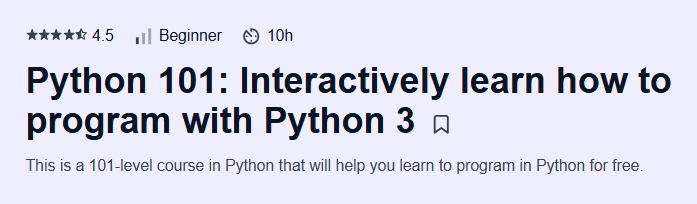
What will you learn in Python 101: Interactively learn how to program with Python 3 Course
-
Understand programming fundamentals using Python syntax.
-
Write clean, readable, and structured Python code.
-
Use data types, loops, conditionals, and functions effectively.
-
Handle files, exceptions, and user input gracefully.
-
Apply object-oriented programming concepts in Python.
Program Overview
Module 1: Getting Started with Python
⏳ 2 hours
-
Topics: Installing Python, running your first script, understanding print statements and comments.
-
Hands-on: Run scripts, write basic programs, and explore syntax in the interactive environment.
Module 2: Variables and Data Types
⏳ 2.5 hours
-
Topics: Strings, integers, floats, booleans, and type conversion.
-
Hands-on: Practice declaring variables, manipulating strings, and performing arithmetic.
Module 3: Conditionals and Loops
⏳ 3 hours
-
Topics: If-else statements, for and while loops, break and continue.
-
Hands-on: Build interactive programs with control flow and logic.
Module 4: Functions and Scope
⏳ 3 hours
-
Topics: Defining functions, return values, parameters, and scope.
-
Hands-on: Write modular and reusable code with functions.
Module 5: Lists and Dictionaries
⏳ 3 hours
-
Topics: Lists, dictionaries, slicing, list comprehensions, dictionary methods.
-
Hands-on: Manipulate data structures and use them in small projects.
Module 6: File I/O and Exceptions
⏳ 2.5 hours
-
Topics: Reading from and writing to files, exception handling.
-
Hands-on: Create programs that save and retrieve data from files.
Module 7: Object-Oriented Programming
⏳ 3.5 hours
-
Topics: Classes, objects, methods, inheritance, encapsulation.
-
Hands-on: Build basic Python classes and create object-oriented solutions.
Module 8: Final Practice Projects
⏳ 3.5 hours
-
Topics: Combine all learned concepts to solve real-world problems.
-
Hands-on: Code multiple mini-projects like a text analyzer or quiz app.
Get certificate
Job Outlook
-
Python is among the most in-demand programming languages in tech, finance, education, and startups.
-
Entry-level Python developers can earn between $60K–$90K, with career paths into data science, web development, automation, and AI.
-
Python knowledge unlocks freelance and remote opportunities across industries.
Explore More Learning Paths
Strengthen your Python programming foundation and prepare for advanced applications with these hand-picked courses designed to enhance your coding skills and practical knowledge.
Related Courses
-
Introduction to Python Course – Build a solid understanding of Python fundamentals and programming logic to support advanced learning.
-
Crash Course on Python Course – Quickly grasp Python essentials and gain hands-on coding experience for real-world tasks.
-
Python Basics Course – Master core Python concepts, data structures, and functions to develop practical programming skills.
Related Reading
-
What Is Python Used For – Explore the versatile applications of Python in data science, AI, web development, automation, and more.