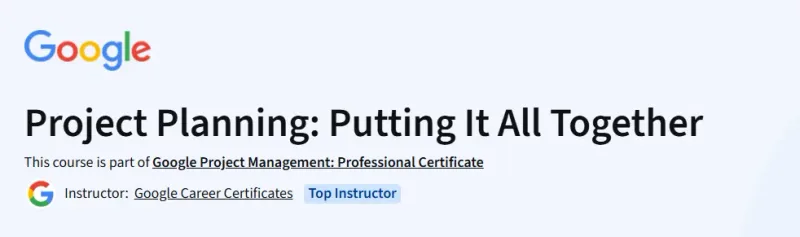
What will you learn in Project Planning: Putting It All Together Course
-
Analyze and define the core components of the project planning phase, including tasks, milestones, and work breakdown structures.
-
Estimate project timelines using techniques like critical path, team-based estimating, and capacity planning.
-
Create and manage budgets, track expenses, and navigate procurement processes with ethical considerations.
-
Implement risk management: identify, categorize, prioritize, mitigate, and communicate risks.
-
Design a communication plan and organize project documentation for clarity and stakeholder alignment.
Program Overview
Module 1: Beginning the Planning Phase
⏳ ~4 hours
-
Topics: Purpose of planning, distinctions between tasks and milestones, work breakdown structures.
-
Hands-on: Create WBS and milestone structures, practice plugin task–milestone alignment.
Module 2: Building a Project Plan
⏳ ~6 hours
-
Topics: Components of a project plan, time-estimation techniques, capacity planning, critical path methodology.
-
Hands-on: Develop a Gantt-chart project schedule and estimate durations using best practices and plugin tools.
Module 3: Managing Budgeting & Procurement
⏳ ~4 hours
-
Topics: Project budgeting components, cost tracking, procurement process, documentation (SOW, ethics).
-
Hands-on: Build project budgets, craft statements of work, and practice procurement reflections.
Module 4: Managing Risks Effectively
⏳ ~4 hours
-
Topics: Risk identification tools, risk categories, mitigation strategies, and stakeholder communication.
-
Hands-on: Develop a risk management plan, assign ownership, and prioritize risk responses.
Module 5: Organizing Communication & Documentation
⏳ ~3 hours
-
Topics: Communication planning, documentation best practices, centralizing project artifacts.
-
Hands-on: Draft a communication plan and structure project documentation repositories.
Get certificate
Job Outlook
-
Prepares you for roles like Project Coordinator, Junior Project Manager, or Scrum Master by covering essential planning-phase skills.
-
Supports attainment of PMI’s CAPM credential, with 100+ hours of formal education credited.
-
Part of a six-course certificate; completion offers entry-level career readiness in project management.
Explore More Learning Paths
Take your project management expertise to the next level with these hand-picked programs designed to enhance your planning, execution, and leadership skills.
Related Courses
-
Engineering Project Management Specialization Course – Master the critical components of engineering projects, including risk, quality, teams, and procurement, from start to finish.
-
Project Initiation: Starting a Successful Project Course – Learn how to define project objectives, align stakeholders, and set the foundation for successful project execution.
-
Introduction to Project Management Course – Build essential project management skills, including planning, scheduling, and resource management for IT and business projects.
Related Reading
-
What Is Project Management? – Understand the principles and methodologies that make projects successful and impactful.