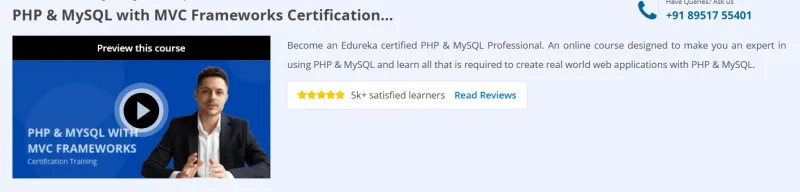
What will you learn in PHP & MySQL with MVC Frameworks Certification Training Course
-
Navigate PHP syntax, variables, data types, control structures, loops, and arrays
-
Write reusable functions and implement robust error handling techniques
-
Apply object-oriented programming principles with classes, inheritance, and encapsulation
-
Install and configure MySQL, perform CRUD operations, and write advanced SQL queries
Program Overview
Module 1: PHP Basics and Conditional Logic
⏳ 2 hours
-
Topics: PHP setup, variables, data types, decision-making statements, loops, arrays
-
Hands-on: Build a basic script that uses conditionals and loops to process data
Module 2: Functions and Error Handling
⏳ 2 hours
-
Topics: Defining functions, parameter handling, return values, try/catch for error control
-
Hands-on: Create reusable functions and implement exception handling in PHP scripts
Module 3: Object Oriented Programming
⏳ 2 hours
-
Topics: Classes, objects, constructors/destructors, inheritance, polymorphism, encapsulation
-
Hands-on: Develop a class hierarchy for a simple domain model and instantiate objects
Module 4: MySQL Installation and Basics
⏳ 2 hours
-
Topics: Installing MySQL, creating databases and tables, basic SQL (SELECT, INSERT, UPDATE, DELETE)
-
Hands-on: Install MySQL locally, create a database schema, and perform CRUD operations
Module 5: Advanced Queries & Data Manipulation
⏳ 2 hours
-
Topics: JOINs, subqueries, aggregate functions, prepared statements, transactions
-
Hands-on: Use PHP to execute complex SQL queries and handle results securely
Module 6: MVC Basics & Introduction to CakePHP
⏳ 2 hours
-
Topics: MVC concepts, CakePHP project structure, conventions over configuration
-
Hands-on: Scaffold a new CakePHP application and explore its directory layout
Module 7: CakePHP Controllers, Views & Layouts
⏳ 2 hours
-
Topics: Controller actions, view templates, layout inheritance, element usage
-
Hands-on: Build CRUD controllers and create corresponding view files
Module 8: Models & Database Interaction in CakePHP
⏳ 2 hours
-
Topics: Model definitions, associations (hasOne/hasMany), data validation, ORM queries
-
Hands-on: Configure models and perform data retrieval and persistence
Module 9: Dynamic Forms with CakePHP Html Helper
⏳ 2 hours
-
Topics: Form helper methods, validation rules, flash messaging
-
Hands-on: Create and validate a multi-field form for user input
Module 10: Building Your CakePHP Website
⏳ 2 hours
-
Topics: Routing, component integration, deployment considerations
-
Hands-on: Complete a mini-website that ties together controllers, views, and models
Get certificate
Job Outlook
-
The average PHP Developer salary in the U.S. is $74,372 as of June 1, 2025
-
Employment of web developers, including PHP roles, is projected to grow 15% by 2026, outpacing average job growth
-
PHP remains a cornerstone for backend web development in e-commerce, content management, and SaaS applications.
-
Freelance and contract opportunities abound for PHP developers working with startups and small businesses.
Explore More Learning Paths
Enhance your web development skills with PHP, MySQL, and MVC frameworks through these carefully curated courses designed to help you build dynamic, data-driven web applications.
Related Courses
-
Building Web Applications in PHP Course – Learn to develop functional and scalable web applications using PHP.
-
PHP & MySQL Certification Course for Beginners Course – Master the basics of PHP and MySQL to create interactive and database-driven websites.
-
The Complete PHP Full Stack Web Developer Bootcamp Course – Gain full-stack development skills using PHP, MySQL, and modern frameworks for real-world projects.
Related Reading
-
What Is Python Used For – Explore Python’s role in web development, automation, and backend programming as a complementary skill.