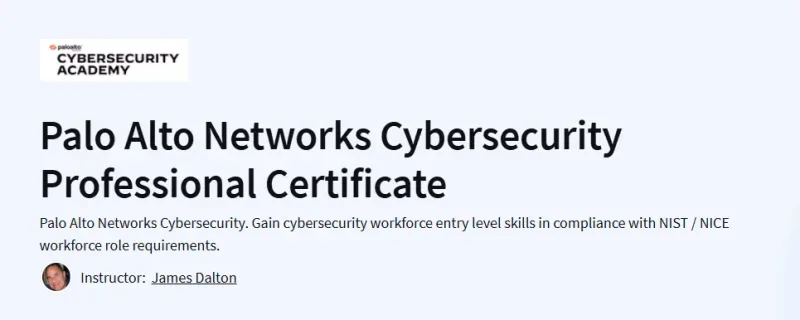
What you will learn in Palo Alto Networks Cybersecurity Professional Certificate Course
- Foundational cybersecurity concepts and threat landscape
- Network security principles and firewall technologies
- Cloud security fundamentals and Zero Trust architecture
- Endpoint protection and threat prevention techniques
- Security operations center (SOC) basics
- Cybersecurity career pathways and industry certifications
Program Overview
Cybersecurity Foundation
⏱️ 4-5 weeks
- This comprehensive introduction covers the cybersecurity kill chain, common attack vectors, and security frameworks.
- Students analyze real-world breaches, understand compliance requirements, and explore Palo Alto’s security operating platform.
- Hands-on labs include basic traffic analysis and security policy creation.
Network Security Essentials
⏱️5-6 weeks
- Focusing on Palo Alto’s Next-Generation Firewalls, this section teaches security policy configuration, application identification, and user-ID integration.
- Students implement threat prevention profiles, analyze logs, and configure VPNs. Includes network segmentation strategies and decryption policies.
Cloud Security Principles
⏱️ 4-6 weeks
- Covering Prisma Cloud capabilities, this module implements cloud security posture management, workload protection, and SaaS security configuration.
- Students deploy virtual firewalls in AWS/Azure, configure security groups, and analyze cloud traffic patterns. Includes CASB fundamentals.
Endpoint Protection
⏱️ 4-5 weeks
- This hands-on section explores Cortex XDR deployment, malware analysis, and behavioral threat detection.
- Students configure endpoint policies, investigate security alerts, and practice incident response procedures. Includes EDR vs. antivirus comparison and ransomware prevention techniques.
SOC Operations
⏱️ 5-6 weeks
- Introducing Cortex XSIAM, this module teaches security monitoring, alert triage, and incident investigation.
- Students analyze SIEM data, create automated playbooks, and practice threat hunting techniques. Covers MITRE ATT&CK framework application.
Cybersecurity Capstone
⏱️6-8 weeks
- Students complete a simulated enterprise security scenario implementing network, cloud, and endpoint protections.
- The project includes security architecture design, policy implementation, threat response, and executive briefing preparation.
Get certificate
Job Outlook
- Salary range: 60K120K for entry/mid-level cybersecurity roles
- Industry demand: 35% growth projected for cybersecurity jobs (BLS)
- Top employers: Palo Alto partners, MSSPs, enterprise security teams
- Career paths: Security Analyst → Engineer → Architect
- Certification value: Pathway to Palo Alto PCCET and PCNSA
Explore More Learning Paths
Enhance your cybersecurity expertise with these carefully curated programs designed to strengthen your skills in defending networks, managing risks, and implementing advanced security strategies.
Related Courses
-
Introduction to Cybersecurity: Tools & Cyberattacks Course – Learn the essentials of cybersecurity, including common attack types and the tools used to detect and prevent them.
-
Cybersecurity Fundamentals Specialization Course – Develop a solid understanding of cybersecurity principles, risk assessment, and protective measures for modern IT systems.
-
Cybersecurity for Business Specialization Course – Focus on applying cybersecurity knowledge in business settings to safeguard organizational data and critical infrastructure.
Related Reading
Gain deeper insight into managing and mitigating digital risks:
-
What Is Risk Management? – Explore strategies for identifying, analyzing, and mitigating risks, a critical aspect of effective cybersecurity practice.