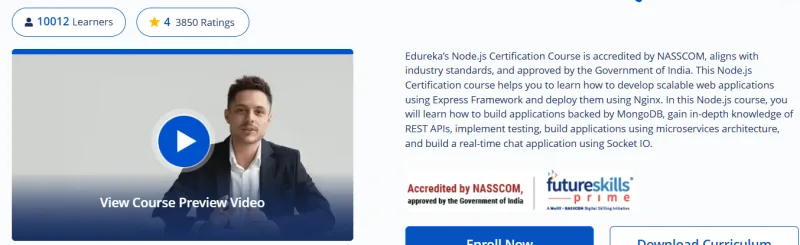
What will you learn in Node JS Course with Certification Course
-
Build scalable server-side applications with Node.js and Express.js
-
Work with asynchronous patterns: callbacks, Promises, and
async/await -
Interact with databases (MongoDB, MySQL) using ORMs and native drivers
-
Implement RESTful APIs, WebSocket real-time communication, and microservices
-
Secure applications with JWT authentication, OAuth integration, and input validation
-
Debug, test (Mocha/Chai), and deploy Node.js apps using Docker, PM2, and CI/CD pipelines
Program Overview
Module 1: Node.js Fundamentals & Environment Setup
⏳ 1 week
-
Topics: Node.js architecture, NPM/Yarn package management, ES6+ syntax
-
Hands-on: Initialize a project, install dependencies, and build a “Hello World” HTTP server
Module 2: Asynchronous JavaScript Patterns
⏳ 1 week
-
Topics: Callbacks vs. Promises, error handling,
async/await, event loop internals -
Hands-on: Refactor callback-based code to Promises and
async/await
Module 3: Building RESTful APIs with Express
⏳ 1 week
-
Topics: Routing, middleware, error-handling, request validation (Joi)
-
Hands-on: Create CRUD endpoints for a task management API
Module 4: Database Integration
⏳ 1 week
-
Topics: MongoDB with Mongoose, MySQL with Sequelize, schema design, migrations
-
Hands-on: Connect your API to both MongoDB and MySQL backends, implement data models
Module 5: Real-Time Communication & Microservices
⏳ 1 week
-
Topics:
socket.iofor WebSockets, service decomposition, messaging patterns -
Hands-on: Add a chat feature to your app and split functionality into two microservices
Module 6: Authentication & Security
⏳ 1 week
-
Topics: JWT, OAuth2 flows (Google/Facebook social login), Helmet, rate limiting, CORS
-
Hands-on: Secure API routes, issue and verify tokens, implement role-based access
Module 7: Testing & Debugging
⏳ 1 week
-
Topics: Unit testing with Mocha/Chai, integration tests, debugging with Chrome DevTools
-
Hands-on: Write tests for API endpoints and debug a memory-leak scenario
Module 8: Deployment & DevOps
⏳ 1 week
-
Topics: Dockerfile creation, PM2 process management, CI/CD with Jenkins/GitHub Actions
-
Hands-on: Containerize your microservices, configure a CI pipeline, and deploy to AWS
Get certificate
Job Outlook
-
Node.js developers are in high demand for backend, full-stack, and microservices roles
-
Common titles: Backend Engineer, Full-Stack JavaScript Developer, API Specialist, DevOps Engineer
-
Salaries range from $90,000 to $140,000+ depending on experience and location
-
Expertise in Node.js and its ecosystem accelerates career growth in tech startups and large enterprises alike
Explore More Learning Paths
Take your backend and full-stack development skills to the next level with these hand-picked programs designed to strengthen your JavaScript expertise and boost your engineering career.
Related Courses
-
JavaScript Programming with React, Node & MongoDB Specialization Course – Build dynamic full-stack applications using modern JavaScript frameworks and databases.
-
Building Full-Stack Web Applications with Node.js and React Course – Learn how to architect and deploy production-ready full-stack apps using Node.js for backend and React for frontend.
-
The Modern GraphQL Bootcamp with Node.js and Apollo Course – Master GraphQL APIs using Node.js and Apollo to build fast, efficient, and scalable backend services.
Related Reading
Gain deeper insight into how project management drives real-world success:
-
What Is Project Management? – Understand the principles that make every great project a success story.