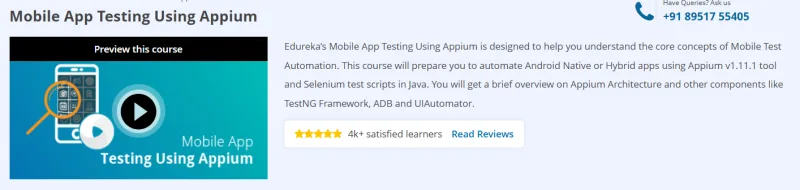
What will you learn in Mobile App Testing Using Appium Course
-
Set up and configure Appium for Android and iOS automation, including SDKs, emulators/simulators, and device farms
-
Write robust mobile test scripts using the Appium client libraries (Java/Python) and TestNG/JUnit frameworks
-
Automate native, hybrid, and mobile-web applications: element identification (UIAutomator, XCUITest), gestures, and context switching
-
Implement advanced features: data-driven testing, page object model, parallel execution on Appium Grid, and integration with Selenium Grid
Program Overview
Module 1: Introduction to Mobile Automation & Appium
⏳ 1 hour
-
Topics: Mobile testing concepts, Appium architecture, client–server model
-
Hands-on: Install Java/Python bindings, Node.js, and configure Android SDK & Xcode for iOS
Module 2: Setting Up the Automation Environment
⏳ 2 hours
-
Topics: Configuring emulators/simulators, real device setup, Appium Inspector
-
Hands-on: Launch emulator and simulator, inspect app elements, and write your first “Hello Appium” test
Module 3: Locators & Basic Test Scripts
⏳ 2 hours
-
Topics: Finding elements by accessibility ID, UIAutomator2 (Android), XCUITest (iOS), XPath; implicit/explicit waits
-
Hands-on: Automate basic app flows—launch app, click buttons, enter text, and verify UI elements
Module 4: Native & Hybrid App Automation
⏳ 2.5 hours
-
Topics: Context switching between native and webview, automating hybrid apps, handling web-based screens
-
Hands-on: Automate a sample hybrid application, switch contexts, and interact with web elements
Module 5: Gestures & Advanced Interactions
⏳ 1.5 hours
-
Topics: Touch actions (tap, swipe, pinch, scroll), multi-touch gestures, device rotation, and biometric simulations
-
Hands-on: Script complex gesture sequences and validate their effects within the app
Module 6: Framework Design & Page Object Model
⏳ 2 hours
-
Topics: Designing reusable test frameworks, implementing Page Object Model (POM), data-driven testing with Excel/CSV
-
Hands-on: Refactor existing scripts into POM structure and parameterize tests for multiple data sets
Module 7: Parallel Execution & Device Farms
⏳ 1.5 hours
-
Topics: Setting up Appium Grid, parallel test execution across devices, integrating with BrowserStack/Sauce Labs
-
Hands-on: Configure a local Appium Grid and run tests concurrently on multiple Android and iOS devices
Module 8: Reporting, CI/CD Integration & Best Practices
⏳ 1.5 hours
-
Topics: Generating HTML/XML reports, capturing logs/screenshots, integrating tests into Jenkins pipelines
-
Hands-on: Create a Jenkins job to trigger Appium tests on code commits and publish test reports
Get certificate
Job Outlook
-
Mobile Automation Engineer: $80,000–$120,000/year — design and execute mobile automation test suites for consumer and enterprise apps
-
QA Automation Architect: $90,000–$140,000/year — architect scalable frameworks supporting cross-platform testing and CI/CD integration
-
DevOps/TestOps Engineer: $85,000–$130,000/year — integrate automated mobile tests into DevOps pipelines, leverage cloud device farms
Explore More Learning Paths
Take your engineering and management expertise to the next level with these hand-picked programs designed to expand your skills and boost your leadership potential.
Related Courses
-
Generative AI for Mobile App Developers Specialization Course – Learn how AI-powered workflows can enhance mobile app development, automate tasks, and accelerate delivery.
-
Modern Android App Development with Java Course – Strengthen your Android development skills by mastering Java-based app architecture, UI design, and real-world app-building techniques.
-
Design & Prototype a Mobile UI/UX Experience (Learn Figma) Course – Build intuitive, user-centered mobile interfaces and learn professional design workflows using Figma.
Related Reading
-
What Is Project Management? – Understand the principles that make every great project a success story.