9.6/10
Highly Recommended
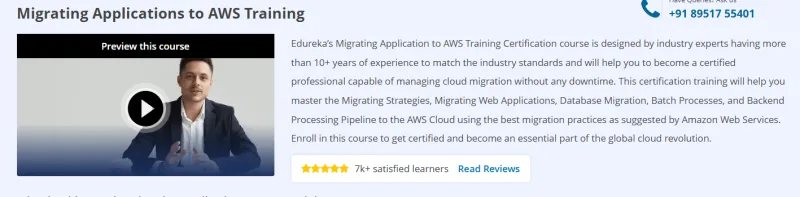
Migrating Applications to AWS Training Course on Edureka — This Edureka course provides a solid end-to-end view of migrating workloads to AWS, combining theory with practical labs. It’s ideal for on-premises teams and cloud practitioners who need hands-on migration experience.
Pros
- Detailed coverage of AWS SMS and DMS tools
- Realistic migration labs with minimal downtime focus
- Clear explanation of migration strategies and planning
Cons
- Limited focus on large-scale data lake migrations
- No deep dive into hybrid network architectures
Migrating Applications to AWS Training Course Course
Platform: Edureka
Instructor: Unknown
What will you learn in Migrating Applications to AWS Training Course
-
Understand core AWS services and cloud concepts such as EC2, S3, and VPC.
-
Assess on-premises environments and plan migration strategies.
-
Migrate virtual machines, databases, and applications to AWS.
-
Implement AWS Database Migration Service (DMS) and Server Migration Service (SMS).
Program Overview
Module 1: AWS Fundamentals & Assessment
⏳ 2 hours
-
Topics: AWS global infrastructure, shared responsibility model, discovery and assessment.
-
Hands-on: Use AWS Application Discovery Service to inventory on-premises assets.
Module 2: Planning & Migration Strategies
⏳ 2.5 hours
-
Topics: 6 R’s (Rehost, Replatform, Refactor…), TCO analysis, migration workforce roles.
-
Hands-on: Develop a migration plan using the AWS Migration Readiness Assessment.
Module 3: Server & VM Migration
⏳ 3 hours
-
Topics: AWS Server Migration Service (SMS), replication jobs, incremental sync.
-
Hands-on: Migrate a sample VM from on-premises to an EC2 instance.
Module 4: Database Migration
⏳ 3 hours
-
Topics: AWS Database Migration Service (DMS), homogeneous vs. heterogeneous migrations.
-
Hands-on: Migrate a MySQL database to Amazon RDS MySQL with minimal downtime.
Module 5: Application Migration & Modernization
⏳ 2.5 hours
-
Topics: Containerization with ECS/EKS, refactoring for serverless, AWS Lambda integration.
-
Hands-on: Containerize a legacy app and deploy to AWS Fargate.
Module 6: Networking & Security Post-Migration
⏳ 2 hours
-
Topics: VPC design, security groups, IAM roles and policies, encryption at rest/in-transit.
-
Hands-on: Configure VPC peering and IAM roles for migrated workloads.
Module 7: Optimization & Cost Management
⏳ 2 hours
-
Topics: AWS Cost Explorer, Trusted Advisor, autoscaling, monitoring with CloudWatch.
-
Hands-on: Set up cost alerts and implement an autoscaling group for EC2.
Job Outlook
-
Cloud migration specialists and AWS architects are in high demand across enterprises and consulting firms.
-
Roles include Cloud Engineer, Solutions Architect, and DevOps Engineer with salaries averaging $110K–$150K USD.
-
Skills in AWS migration tools and best practices are sought for digital transformation projects.
-
Experience in cost optimization and operational excellence enhances career prospects.
FAQs
Do I need prior AWS experience to take this course?
Basic understanding of cloud concepts is helpful but not mandatory. The course introduces core AWS services like EC2, S3, and VPC. Step-by-step labs guide learners through migration processes. Prior IT or on-premises administration knowledge can help. Beginners can follow along with the hands-on exercises effectively.
Can this course help migrate databases and virtual machines?
Yes, covers server and VM migration using AWS SMS. Includes database migration with AWS DMS. Hands-on labs show real migration scenarios with minimal downtime. Learners can migrate MySQL, PostgreSQL, and other databases. Prepares learners to handle typical enterprise migration tasks.
Will I learn how to optimize costs after migration?
Covers AWS Cost Explorer and Trusted Advisor tools. Teaches autoscaling and monitoring with CloudWatch. Hands-on labs include setting up cost alerts. Focuses on operational efficiency and performance optimization. Helps learners implement cost-effective AWS deployments.
Does the course cover application modernization on AWS?
Introduces containerization with ECS and EKS. Covers serverless integration with AWS Lambda. Hands-on lab includes containerizing legacy apps for Fargate. Teaches refactoring strategies for cloud-native applications. Helps learners modernize applications while migrating to AWS.
What career opportunities are available after this training?
Roles include Cloud Engineer, Solutions Architect, and DevOps Engineer. Expertise in AWS migration tools is in high demand across enterprises. Average salaries range from $110K–$150K USD. Skills support digital transformation projects and operational excellence. Enhances resumes for both IT teams and consulting positions.