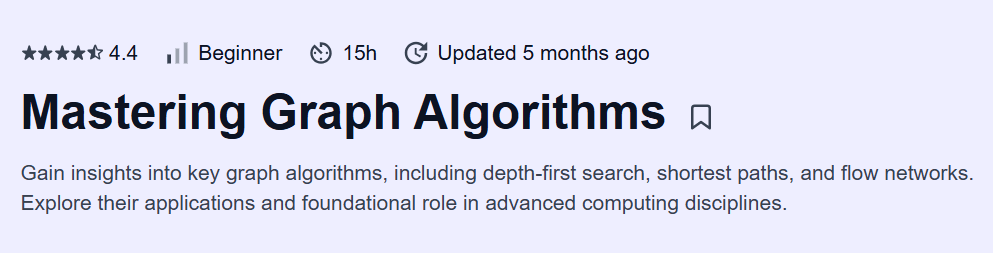
What will you learn in Mastering Graph Algorithms Course
-
Model real-world problems as graphs and understand core graph representations (adjacency lists, matrices)
-
Traverse graphs using BFS and DFS, and apply these for connectivity, cycle detection, and topological sorting
-
Compute shortest paths with Dijkstra’s, Bellman–Ford, and A* algorithms, including handling negative weights
-
Build minimum spanning trees via Kruskal’s and Prim’s algorithms for network design and clustering
-
Solve advanced flow problems: Ford–Fulkerson, Edmonds–Karp, and maximum bipartite matching
Program Overview
Module 1: Graph Fundamentals & Representations
⏳ 1 hour
-
Topics: Definitions, directed vs. undirected, weighted vs. unweighted, adjacency structures
-
Hands-on: Implement and compare adjacency list and matrix representations
Module 2: Breadth-First & Depth-First Search
⏳ 1.5 hours
-
Topics: BFS for shortest unweighted paths, DFS for connectivity, cycle detection, and backtracking
-
Hands-on: Code BFS/DFS routines; apply DFS to find connected components and topological sort
Module 3: Shortest Path Algorithms
⏳ 2 hours
-
Topics: Dijkstra’s algorithm with priority queues, Bellman–Ford for negative edges, A* heuristics
-
Hands-on: Implement each algorithm; compare performance on sample road-network data
Module 4: Minimum Spanning Trees
⏳ 1.5 hours
-
Topics: Greedy strategies, Kruskal’s with Union-Find, Prim’s with heaps
-
Hands-on: Build MSTs for weighted graphs and visualize resulting tree structures
Module 5: Network Flow & Matching
⏳ 2 hours
-
Topics: Max-flow/min-cut theorem, Ford–Fulkerson, Edmonds–Karp, bipartite matching via flow reduction
-
Hands-on: Solve flow problems on capacity graphs and implement bipartite matching
Module 6: Advanced Topics & Applications
⏳ 1.5 hours
-
Topics: Graph coloring, strongly connected components (Kosaraju’s/Tarjan’s), planarity and embeddings
-
Hands-on: Detect SCCs in directed graphs; apply graph coloring to scheduling problems
Module 7: Real-World Case Studies
⏳ 1 hour
-
Topics: Recommendation systems via graph algorithms, influence maximization, route optimization
-
Hands-on: Prototype a simple friend-recommendation engine and a shortest-route planner
Module 8: Capstone Project – End-to-End Graph Solver
⏳ 2 hours
-
Topics: Problem selection, algorithm choice, performance tuning, and scalability considerations
-
Hands-on: Build a full-featured graph-analysis tool that ingests dataset, runs selected algorithms, and visualizes results
Get certificate
Job Outlook
-
Algorithm Engineer: $100,000–$150,000/year — design and optimize graph-based solutions for search, recommendation, and AI pipelines
-
Data Scientist / Machine Learning Engineer: $110,000–$160,000/year — apply graph analytics in network analysis, knowledge graphs, and NLP
-
Software Engineer (Backend / Infrastructure): $90,000–$140,000/year — implement scalable graph-processing systems in domains such as logistics and social networks
-
Mastering graph algorithms positions you for roles at top tech companies working on search engines, social platforms, and high-performance computing.
Explore More Learning Paths
Take your engineering and management expertise to the next level with these hand-picked programs designed to expand your skills and boost your leadership potential.
Related Courses
-
Advanced Learning Algorithms Course – Deepen your understanding of advanced algorithmic concepts and strengthen your ability to solve complex computational problems.
-
Advanced Learning Algorithms Course – Explore high-level algorithmic techniques to enhance your capability in designing efficient, scalable solutions.
Related Reading
-
What Is Project Management? – Understand the principles that make every great project a success story.