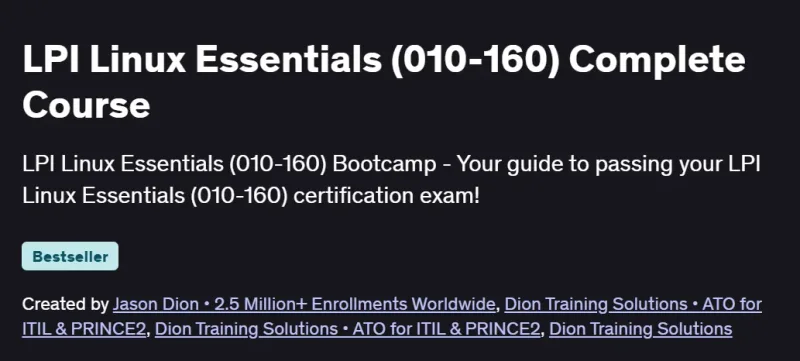
What will you in LPI Linux Essentials (010-160) Complete Course
- Understand Linux operating system fundamentals and command-line basics.
- Navigate the filesystem, manage files and directories, and use text editors.
- Control user and group permissions, and manage file ownership.
- Install and update software packages using common package managers.
- Monitor system processes, manage services, and inspect logs.
- Configure basic networking, and understand boot processes and runlevels.
Program Overview
Module 1: Introduction to Linux & Lab Setup
⏳ 30 minutes
-
Overview of Linux distributions, history, and open-source philosophy.
-
Set up a virtual machine or cloud instance for hands-on practice.
-
Navigate the Bash shell and basic command syntax.
Module 2: File System Navigation & Management
⏳ 1 hour
-
Use commands like
ls,cd,pwd,cp,mv, andrm. -
Understand absolute vs. relative paths and special directories.
-
Employ wildcards and globbing for efficient file handling.
Module 3: Text Editing with Vim and Nano
⏳ 45 minutes
-
Open, edit, and save files using Nano.
-
Navigate, insert, delete, and save changes in Vim.
-
Customize editor settings and use basic search commands.
Module 4: Users, Groups & Permissions
⏳ 1 hour
-
Create and manage users and groups with
useraddandgroupadd. -
Modify permissions using
chmod,chown, andchgrp. -
Apply special permissions (setuid, setgid, sticky bit) in practice.
Module 5: Package Management & Software Installation
⏳ 45 minutes
-
Install, update, and remove packages using
apt,yum, ordnf. -
Explore repository configurations and search for packages.
-
Compile and install software from source.
Module 6: Process Monitoring & Service Management
⏳ 45 minutes
-
Inspect running processes with
ps,top, andhtop. -
Control jobs using
kill,nice, andrenice. -
Manage system services via
systemctland legacy init scripts.
Module 7: Networking Essentials & Remote Access
⏳ 30 minutes
-
Configure IP addressing, DNS, and routing basics with
ipandnmcli. -
Test connectivity using
ping,traceroute, andnetstat. -
Securely connect using SSH and transfer files with
scpandrsync.
Module 8: Boot Process & Runlevels
⏳ 30 minutes
-
Understand BIOS/UEFI, boot loaders (GRUB), and kernel initialization.
-
Explore runlevels and targets, and switch between them.
-
Diagnose boot issues and recover using rescue modes.
Get certificate
Job Outlook
- High Demand Roles: Linux System Administrator, DevOps Engineer, Site Reliability Engineer.
- Salary Potential: ₹4–12 LPA in India; $70K–$100K annually in the U.S.
- Growth Areas: Cloud infrastructure, container orchestration (Docker, Kubernetes), and automation.
- Freelance Opportunities: Server setup, scripting, and Linux consulting for SMBs and startups.
Explore More Learning Paths
Expand your Linux skills and command-line proficiency with these carefully curated courses designed to strengthen your IT and development capabilities.
Related Courses
-
Tools of the Trade: Linux and SQL Course – Learn how to use Linux alongside SQL to manage systems and databases effectively.
-
Learning Linux for LFCA Certification Specialization Course – Prepare for the LFCA certification while gaining practical Linux administration experience.
-
Hands-On Introduction to Linux Commands and Shell Scripting Course – Develop hands-on expertise with Linux commands and shell scripting for real-world applications.
Related Reading
-
What Is Data Management – Understand how managing data effectively in Linux environments supports IT operations and development workflows.