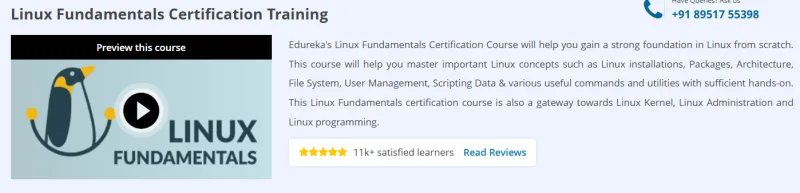
What will you learn in Linux Fundamentals Certification Training Course
-
Navigate the Linux filesystem and shell: commands (
ls,cd,pwd), file permissions, and environment variables -
Manage processes and services:
ps/top, job control (&,fg/bg), systemd units, and cron scheduling -
Automate tasks with shell scripting: variables, conditionals, loops, functions, and I/O redirection
-
Install and manage software packages via
apt/yum, build from source, and configure repositories -
Configure networking fundamentals: IP addressing, DNS resolution, SSH, firewalls (
iptables/firewalld)
Program Overview
Module 1: Introduction & Shell Basics
⏳ 1 hour
-
Topics: Logging in, shell prompt customization, basic file operations (
cp,mv,rm) -
Hands-on: Navigate directories, inspect files, and customize your
PS1prompt
Module 2: File Permissions & Users
⏳ 1 hour
-
Topics: Ownership (
chown), permissions (chmod), special bits (SUID/SGID/sticky), user/group management -
Hands-on: Create users/groups, assign home directories, and set ACLs for shared folders
Module 3: Process & Service Management
⏳ 1 hour
-
Topics: Viewing processes, signaling (
kill), background/foreground jobs, systemd basics (units, targets) -
Hands-on: Launch services, write a custom systemd service file, and schedule a background job
Module 4: Shell Scripting Essentials
⏳ 1.5 hours
-
Topics: Script structure, shebang, variables,
if/else,for/while, functions, error handling -
Hands-on: Write a backup script that archives a directory, logs output, and emails status
Module 5: Package Management & Software Builds
⏳ 1 hour
-
Topics:
aptvs.yum, installing/removing packages, repository configuration, compiling from source -
Hands-on: Add a third-party repo, install software, then download and build a utility from GitHub
Module 6: Networking & Remote Access
⏳ 1 hour
-
Topics:
ip/ifconfig, DNS tools (dig/nslookup), SSH key authentication, firewall basics -
Hands-on: Configure a static IP, test DNS resolution, secure SSH access, and open a port in
firewalld
Module 7: Disk & Storage Management
⏳ 1 hour
-
Topics: Partitioning (
fdisk), file systems (mkfs,mount), LVM basics, swap configuration -
Hands-on: Create a new partition, format it, add to LVM, and extend the root volume
Module 8: Monitoring & Troubleshooting
⏳ 1 hour
-
Topics: Logs (
journalctl,/var/log), resource monitoring, basic performance tuning -
Hands-on: Analyze system logs for errors, monitor CPU/memory usage, and tune
sysctlparameters
Get certificate
Job Outlook
-
Linux System Administrator: $75,000–$110,000/year — manage servers, automate tasks, and ensure uptime
-
DevOps Engineer: $85,000–$130,000/year — build CI/CD pipelines, containerize apps, and manage infrastructure as code
-
Site Reliability Engineer: $95,000–$150,000/year — design resilient systems, implement monitoring, and handle incident response
-
Mastery of Linux fundamentals underpins roles in cloud infrastructure, cybersecurity, and platform engineering.
Explore More Learning Paths
Take your Linux and open-source system skills to the next level with these hand-picked programs designed to strengthen your command-line proficiency and prepare you for real-world IT environments.
Related Courses
-
Tools of the Trade: Linux and SQL Course – Learn essential Linux commands alongside SQL fundamentals to manage data and systems efficiently.
-
Learning Linux for LFCA Certification Specialization Course – Build foundational Linux knowledge and prepare for the Linux Foundation Certified IT Associate (LFCA) certification.
-
Hands-On Introduction to Linux Commands and Shell Scripting Course – Gain practical experience with Linux command-line tools, shell scripting, and automation tasks.
Related Reading
Gain deeper insight into how structured systems management improves IT operations:
-
What Is Operations Management? – Understand the practices that ensure IT infrastructure and operations run efficiently and effectively.