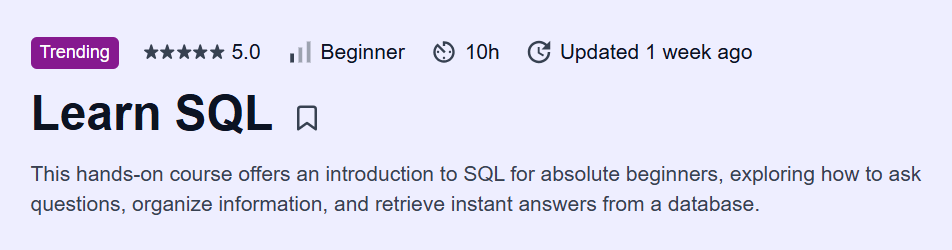
What will you learn in Learn SQL Course
-
Write efficient SQL queries using
SELECT,JOIN,GROUP BY,HAVING, and subqueries -
Design and normalize relational databases with primary/foreign keys and indexing strategies
-
Perform data aggregation, filtering, and window functions for advanced analytics
-
Use DML (
INSERT,UPDATE,DELETE) and DDL (CREATE,ALTER,DROP) statements safely -
Optimize query performance and understand execution plans across popular RDBMS
Program Overview
Module 1: SQL Basics & Setup
⏳ 1 week
-
Topics: Installing and connecting to a database (PostgreSQL/MySQL), basic
SELECTqueries, filtering withWHERE -
Hands-on: Query a sample employees table to retrieve specific records
Module 2: Data Retrieval & Filtering
⏳ 1 week
-
Topics:
ORDER BY,LIMIT, pattern matching withLIKE, logical operators -
Hands-on: Find top-selling products and filter customers by region and purchase history
Module 3: Joining Tables
⏳ 1 week
-
Topics: Inner, left, right, and full outer joins; self-joins; cross joins
-
Hands-on: Combine orders and customer tables to produce consolidated sales reports
Module 4: Aggregation & Grouping
⏳ 1 week
-
Topics:
GROUP BY,HAVING, aggregate functions (SUM,COUNT,AVG,MIN,MAX) -
Hands-on: Calculate monthly revenue, average order value, and identify top 10% of customers
Module 5: Subqueries & Common Table Expressions
⏳ 1 week
-
Topics: Inline subqueries, correlated subqueries,
WITHclauses for modular queries -
Hands-on: Use CTEs to break down a complex nested query into readable steps
Module 6: Window Functions & Advanced Analytics
⏳ 1 week
-
Topics: ROW_NUMBER, RANK, LEAD, LAG, running totals, moving averages
-
Hands-on: Generate sales trends with rolling averages and rank products by performance
Module 7: Data Modification & Transaction Control
⏳ 1 week
-
Topics:
INSERT,UPDATE,DELETE,TRUNCATE; transaction statements (BEGIN,COMMIT,ROLLBACK) -
Hands-on: Safely update inventory quantities and rollback on constraint violations
Module 8: Schema Design & Performance Tuning
⏳ 1 week
-
Topics: Normalization (1NF–3NF), indexing strategies, analyzing execution plans
-
Hands-on: Design a normalized schema for an e-commerce app and optimize slow-running queries
Get certificate
Job Outlook
-
SQL proficiency is essential for roles like Data Analyst, Business Intelligence Developer, and Backend Developer
-
Nearly every industry relies on SQL for data-driven decision making, from finance and healthcare to tech and retail
-
Salaries range from $65,000 to $120,000+ depending on role, experience, and location
-
Mastering SQL opens doors to advanced specialties such as data engineering, analytics engineering, and cloud database administration
Explore More Learning Paths
Strengthen your SQL and database management skills with these carefully selected courses designed to help you query, analyze, and optimize data efficiently.
Related Courses
-
Database Design and Basic SQL in PostgreSQL Course – Learn the fundamentals of database design and SQL using PostgreSQL, including tables, queries, and relationships.
-
Databases and SQL for Data Science with Python Course – Apply SQL skills for data science tasks and integrate Python for data analysis workflows.
-
SQL Server Performance Tuning Part 1 Course – Master techniques to optimize SQL Server queries, improve performance, and handle large-scale databases effectively.
Related Reading
-
What Is Data Management? – Discover how proper data management ensures data integrity, accessibility, and efficient querying for business and analytics purposes.