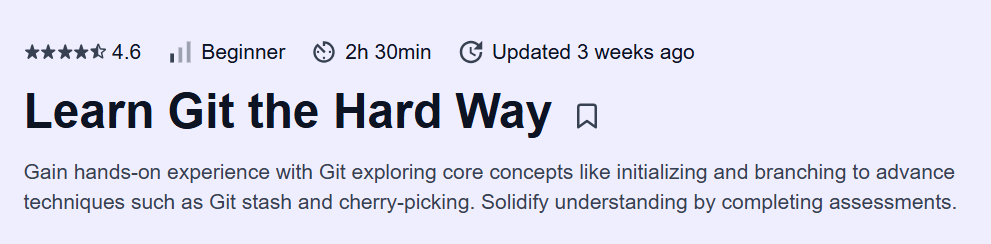
What will you learn in Learn Git the Hard Way Course
- Hands-on Git fundamentals: Initialize repos, stage & commit changes, view history, clone, branch, merge, and resolve conflicts through interactive challenges.
- Advanced Git techniques: Master stash, interactive staging, reflog, cherry-picking, rebase, bisect, managing remote repos, and pull requests.
Program Overview
Module 1: Introduction & Course Walkthrough
⏳ ~10 minutes
-
Topics: Course structure, importance of Git, and how the “Hard Way” interactive approach works.
-
Hands-on: Set up your first session and run basic commands in the built-in terminal.
Module 2: Git Basics
⏳ ~30 minutes
-
Topics: Initialize repos, status checks, add & commit files, and track history.
-
Hands-on: Initialize a repo, make changes, commit, and inspect logs to build foundational skills.
Module 3: Cloning & Branching
⏳ ~25 minutes
-
Topics: Clone remote repos, branch creation, switching, and understanding detached HEAD states.
-
Hands-on: Clone a sample repo, create and switch branches, and recover from typical mistakes.
Module 4: Merging & Conflict Resolution
⏳ ~20 minutes
-
Topics: Merge operations, conflict detection, and best conflict resolution practices.
-
Hands-on: Perform branch merges, create conflicts, and resolve them using Git commands.
Module 5: Git Stash & Interactive Staging
⏳ ~20 minutes
-
Topics: Temporarily stash changes and selectively stage hunks using interactive add.
-
Hands-on: Save changes to stash, reapply them, and use partial staging for fine-grained control.
Module 6: Reflog, Cherry-Pick & Rebase
⏳ ~30 minutes
-
Topics: Recover lost commits with reflog, pick individual commits, and rebase for clean histories.
-
Hands-on: Retrieve deleted commits, cherry-pick features between branches, and perform rebases.
Module 7: Git Bisect & Remote Repo Management
⏳ ~30 minutes
-
Topics: Identify issues using bisect, manage remotes, pull/push, and execute pull requests.
-
Hands-on: Run bisect to locate bugs, configure remotes, push code, and create a pull request workflow.
Module 8: Final Assessment & Advanced Practices
⏳ ~15 minutes
-
Topics: Recap core and advanced commands, final challenge expectations.
-
Hands-on: Complete a comprehensive assessment that tests key Git skills learned.
Get certificate
Job Outlook
- Essential developer skill: Proficiency in Git is expected for all software engineering, DevOps, and collaboration workflows.
- Career versatility: Supports development across roles—backend, devops, QA, and open-source collaboration.
- Foundational toolset: Helps engineers work confidently in real codebases, fix issues, and participate in team workflows.
- Resume-ready: Strong Git skills and understanding of branching/rebasing workflows make you stand out in technical interviews.
Explore More Learning Paths
Take your engineering and management expertise to the next level with these hand-picked programs designed to expand your skills and boost your leadership potential.
Related Courses
-
Git Essentials: Learn Git with Bitbucket and Sourcetree – Build a strong foundation in Git while mastering popular tools like Bitbucket and Sourcetree for efficient team collaboration.
-
Learn Git – Understand the core concepts of version control and learn how to use Git effectively through real-world scenarios.
-
Learn Git by Doing: A Step-by-Step Guide to Version Control – Strengthen your Git skills with hands-on exercises designed to help you confidently manage code changes and collaborate like a pro.
Related Reading
-
What Is Knowledge Management? – Explore how teams capture, organize, and share information—an essential practice for effective version control and software development.