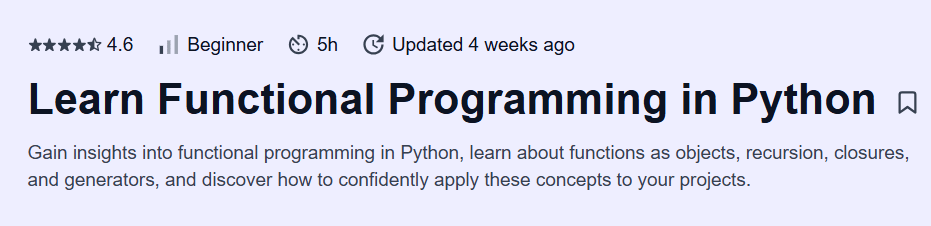
What will you learn in Learn Functional Programming in Python Course
-
Understand the principles of functional programming and how they apply to Python.
-
Use first-class functions, pure functions, and higher-order functions effectively.
-
Work with key functional constructs like
map,filter,reduce, and list comprehensions.
-
Explore lambda expressions, closures, decorators, and recursion.
-
Improve code readability, testability, and reusability through immutability and functional paradigms.
-
Learn to integrate functional programming concepts into real-world Python projects.
Program Overview
Module 1: Introduction to Functional Programming
⏳ 1.5 hours
-
Topics: What is functional programming, imperative vs. functional style, core benefits.
-
Hands-on: Compare imperative and functional code examples in Python.
Module 2: Functions as First-Class Objects
⏳ 2 hours
-
Topics: Assigning functions to variables, passing functions as arguments, returning functions.
-
Hands-on: Build higher-order functions and reusable utilities.
Module 3: Pure Functions and Immutability
⏳ 2 hours
-
Topics: Side effects, referential transparency, using tuples and frozensets.
-
Hands-on: Refactor code to use pure functions and immutable data.
Module 4: Built-In Functional Tools
⏳ 2.5 hours
-
Topics:
map(),filter(),reduce(),zip(), andenumerate(). -
Hands-on: Perform data transformations using these core functions.
Module 5: Lambda Expressions and Closures
⏳ 2 hours
-
Topics: Anonymous functions, capturing variables, variable scoping.
-
Hands-on: Build compact operations using lambdas and nested closures.
Module 6: Recursion and Tail Calls
⏳ 2 hours
-
Topics: Recursion patterns, avoiding stack overflow, converting to iteration.
-
Hands-on: Solve problems like factorial and Fibonacci using recursion.
Module 7: Decorators and Composition
⏳ 2.5 hours
-
Topics: Writing custom decorators, chaining functions, function pipelines.
-
Hands-on: Create decorators for logging, timing, and validation.
Module 8: Real-World Applications
⏳ 2 hours
-
Topics: Using functional programming in data processing and event-driven design.
-
Hands-on: Build a small project demonstrating functional techniques in practice.
Get certificate
Job Outlook
-
Functional programming concepts are highly valued in backend development, data science, and software architecture.
-
Python developers with a functional mindset write more efficient, modular, and testable code.
-
Skills translate well into roles using Scala, Haskell, or functional JavaScript.
-
In-demand in startups and companies that prioritize clean, scalable architectures.
Explore More Learning Paths
Strengthen your Python programming and functional programming skills with these carefully selected courses designed to build a solid foundation and help you write efficient, modular, and maintainable code.
Related Courses
-
Introduction to Python Course – Learn Python fundamentals to support advanced concepts like functional programming.
-
Crash Course on Python Course – Quickly grasp Python essentials and gain practical coding experience for real-world applications.
-
Python Basics Course – Master core Python concepts, data types, and functions to write clean and efficient code.
Related Reading
-
What Is Python Used For – Discover Python’s versatile applications in software development, data science, AI, automation, and more.