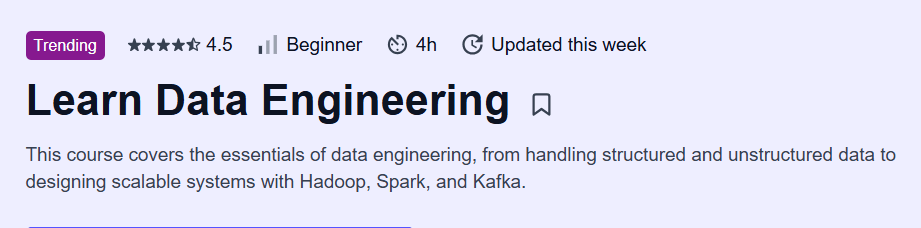
What will you learn in Learn Data Engineering Course
-
Understand the full data engineering lifecycle from ingestion to analytics.
-
Work with key tools like Kafka, Airflow, Spark, and Snowflake.
-
Design and build data pipelines using batch and streaming methods.
-
Handle data transformation, warehousing, and orchestration in real-world scenarios.
-
Build foundational skills for modern data stacks and cloud-based data workflows.
Program Overview
Module 1: Introduction to Data Engineering
⏳ 1.5 hours
-
Topics: What is data engineering, role in the data team, lifecycle overview.
-
Hands-on: Identify components of a modern data stack and project workflow.
Module 2: Ingestion Layer
⏳ 2.5 hours
-
Topics: Batch vs. streaming ingestion, Kafka basics, file sources, APIs.
-
Hands-on: Simulate ingestion using Kafka and flat files.
Module 3: Transformation Layer
⏳ 2.5 hours
-
Topics: Data cleaning, enrichment, ETL vs. ELT, SQL and Python tools.
-
Hands-on: Build basic transformation logic using pandas and SQL.
Module 4: Orchestration with Airflow
⏳ 2 hours
-
Topics: DAGs, scheduling, monitoring, retries, dependencies.
-
Hands-on: Set up and deploy a basic Airflow DAG.
Module 5: Storage and Warehousing
⏳ 2 hours
-
Topics: Columnar vs. row-based storage, warehouse concepts, intro to Snowflake.
-
Hands-on: Load data into a Snowflake warehouse and query using SQL.
Module 6: Processing with Spark
⏳ 3 hours
-
Topics: Spark architecture, RDDs vs. DataFrames, parallelism.
-
Hands-on: Process large datasets using PySpark.
Module 7: Real-World Project: End-to-End Pipeline
⏳ 3.5 hours
-
Topics: Combining tools in a real pipeline from source to dashboard.
-
Hands-on: Build a full pipeline using ingestion, transformation, orchestration, and warehousing.
Get certificate
Job Outlook
-
Data engineers are in high demand across industries including tech, healthcare, finance, and e-commerce.
-
Strong salaries ranging from $100K–$160K+ depending on experience and stack.
-
Skills in Airflow, Kafka, Spark, and cloud platforms are increasingly sought-after.
-
Freelance and remote roles growing in data infrastructure and analytics engineering.
Explore More Learning Paths
Enhance your data engineering expertise with these carefully selected courses designed to help you manage, process, and optimize data pipelines using modern tools and techniques.
Related Courses
-
DeepLearning.AI Data Engineering Professional Certificate Course – Gain comprehensive knowledge in designing and managing scalable data pipelines and engineering workflows.
-
Introduction to Data Engineering by IBM – Learn the fundamentals of data engineering and prepare for real-world data pipeline projects.
-
Data Engineering Foundations Specialization Course – Explore key concepts, tools, and techniques for effective data management and processing.
Related Reading
-
What Does a Data Engineer Do – Understand the responsibilities and impact of data engineers in managing and optimizing data systems.