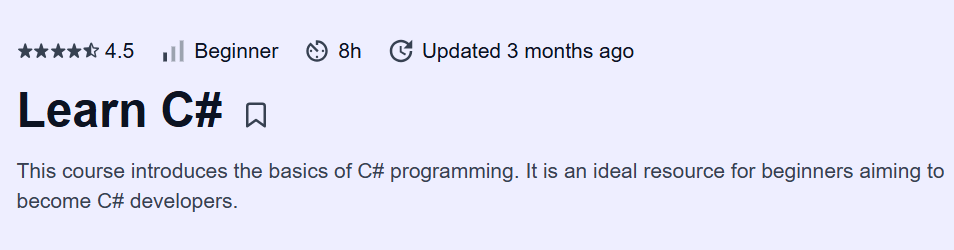
What will you learn in Learn C# Course
-
Master C# fundamentals: types, control flow, classes, and error handling
-
Leverage object-oriented principles: inheritance, interfaces, polymorphism, and encapsulation
-
Work with collections, LINQ queries, and asynchronous programming with
async/await
-
Build and structure real-world applications using .NET Core, dependency injection, and configuration
-
Debug, test, and deploy C# applications, including unit testing with xUnit and NuGet packaging
Program Overview
Module 1: C# Language Basics
⏳ 1 week
-
Topics: Primitive types, variables, operators,
if/switch, loops (for,while) -
Hands-on: Write console programs to perform calculations and control-flow exercises
Module 2: Methods, Error Handling & Debugging
⏳ 1 week
-
Topics: Method signatures, overloads, exception types,
try/catch/finally, debugger tools -
Hands-on: Implement reusable methods and introduce error handling in sample apps
Module 3: Classes & Object-Oriented Design
⏳ 1 week
-
Topics: Defining classes and structs, properties, constructors, access modifiers
-
Hands-on: Model a domain (e.g., inventory system) with classes and test object interactions
Module 4: Inheritance, Interfaces & Polymorphism
⏳ 1 week
-
Topics: Base vs. derived classes, abstract classes, interface contracts, virtual/override methods
-
Hands-on: Extend a base
Animalclass and implement multiple behaviors via interfaces
Module 5: Collections & LINQ
⏳ 1 week
-
Topics: Arrays,
List<T>, dictionaries, querying with LINQ methods and query syntax -
Hands-on: Manipulate and query sample datasets (e.g., customer orders) using LINQ
Module 6: Asynchronous Programming
⏳ 1 week
-
Topics:
Taskvs.Task<T>,async/await,CancellationToken, parallel loops -
Hands-on: Build an HTTP client that fetches data concurrently and handles cancellations
Module 7: .NET Core & Dependency Injection
⏳ 1 week
-
Topics: Project templates,
appsettings.json, built-in DI container, service lifetimes -
Hands-on: Scaffold a minimal Web API and wire up services via constructor injection
Module 8: Testing & Packaging
⏳ 1 week
-
Topics: Unit testing with xUnit, mocking with Moq, creating and publishing NuGet packages
-
Hands-on: Write tests for business logic and publish a utility library to a local feed
Module 9: Capstone Project – Complete .NET Core App
⏳ 2 weeks
-
Topics: End-to-end design: API, data layer, UI (e.g., Blazor), logging and configuration
-
Hands-on: Deliver a full-stack sample—backend API, simple frontend, CI/CD pipeline
Get certificate
Job Outlook
-
C# developers are in high demand for backend, desktop, and game development (Unity) roles
-
Positions include .NET Developer, Software Engineer, Full-Stack .NET Engineer, and Unity Programmer
-
Salaries range from $80,000 to $140,000+ depending on experience and region
-
Mastery of C#, .NET Core, and modern practices opens doors to enterprise projects, microservices, and cross-platform apps
Explore More Learning Paths
Expand your C# and software development expertise with these hand-picked programs designed to strengthen your fundamentals, enhance your problem-solving skills, and prepare you for real-world engineering challenges.
Related Courses
-
C# Programming for Unity Game Development Specialization Course – Learn how to apply C# in game development by building interactive 2D and 3D projects with Unity.
-
C# Basics for Beginners: Learn C# Fundamentals by Coding Course – Master the core C# concepts through hands-on coding exercises designed for complete beginners.
-
C# Concurrency for Senior Engineering Interviews Course – Prepare for high-level engineering interviews with in-depth training in concurrency, multithreading, and scalable system design using C#.
Related Reading
Gain deeper insight into how project management drives real-world success:
-
What Is Project Management? – Understand the principles that make every great project a success story.