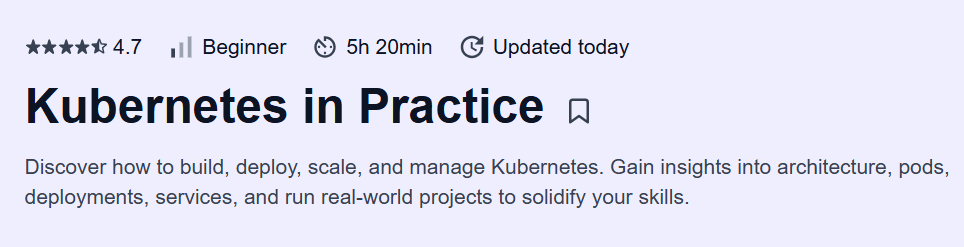
What will you learn in Kubernetes in Practice Course
-
Deploy and manage containerized applications on Kubernetes clusters
-
Understand Kubernetes core primitives: Pods, Deployments, Services, ConfigMaps, and Secrets
-
Configure networking and load balancing with Ingress controllers and Services
-
Implement stateful workloads using StatefulSets, PersistentVolumes, and PersistentVolumeClaims
-
Automate application rollouts, rollbacks, and scaling with Deployments and Horizontal Pod Autoscalers
-
Secure clusters with RBAC, NetworkPolicies, and PodSecurityPolicies
Program Overview
Module 1: Kubernetes Fundamentals & Cluster Setup
⏳ 1 week
-
Topics: Kubernetes architecture, control plane vs. worker nodes,
kubectlbasics -
Hands-on: Provision a local cluster with Minikube/Kind and deploy a “Hello World” Pod
Module 2: Managing Pods & Deployments
⏳ 1 week
-
Topics: Pod lifecycle, ReplicaSets, Deployment strategies (Recreate vs. RollingUpdate)
-
Hands-on: Create Deployments, perform rolling updates, and roll back to previous versions
Module 3: Services & Networking
⏳ 1 week
-
Topics: ClusterIP, NodePort, LoadBalancer Services, Ingress resources
-
Hands-on: Expose applications via Services and configure an NGINX Ingress controller
Module 4: Configuration & Secrets Management
⏳ 1 week
-
Topics: ConfigMaps for config injection, Secrets for sensitive data, environment vs. volume mounts
-
Hands-on: Store database credentials in Secrets and inject them into application Pods
Module 5: Stateful Workloads & Storage
⏳ 1 week
-
Topics: PersistentVolumes, PersistentVolumeClaims, StorageClasses, StatefulSets
-
Hands-on: Deploy a stateful application (e.g., MySQL) using StatefulSets and dynamic provisioning
Module 6: Scaling & Auto-Scaling
⏳ 1 week
-
Topics: Manual vs. automatic scaling, Horizontal Pod Autoscaler (HPA), Cluster Autoscaler basics
-
Hands-on: Load-test a service and configure HPA to adjust replica count automatically
Module 7: Security & Access Control
⏳ 1 week
-
Topics: RBAC roles and bindings, ServiceAccounts, NetworkPolicies, PodSecurityPolicies
-
Hands-on: Lock down a namespace with restrictive RBAC rules and network segmentation
Module 8: Observability & Troubleshooting
⏳ 1 week
-
Topics: Logging with
kubectl logs, metrics with Prometheus, dashboards with Grafana,kubectl debug -
Hands-on: Set up a Prometheus/Grafana stack and troubleshoot a failing Pod with logging and metrics
Get certificate
Job Outlook
-
Kubernetes expertise is in high demand for roles like DevOps Engineer, Site Reliability Engineer, and Platform Engineer
-
Widely adopted across cloud providers, microservices architectures, and enterprise CI/CD pipelines
-
Salaries range from $100,000 to $160,000+ depending on region and level of responsibility
-
Mastery of Kubernetes accelerates productivity, reliability, and scalability in production environments
Explore More Learning Paths
Strengthen your Kubernetes and cloud-native application skills with these hand-picked programs designed to help you deploy, manage, and scale containerized applications efficiently.
Related Courses
-
Getting Started with Google Kubernetes Engine Course – Learn the fundamentals of deploying and managing containerized applications on Google Kubernetes Engine (GKE).
-
Architecting with Google Kubernetes Engine en Español Specialization Course – Master Kubernetes architecture and workload management on GKE with comprehensive, hands-on lessons in Spanish.
-
Architecting with Google Kubernetes Engine Workloads Course – Dive deeper into workload deployment, scaling, and monitoring for complex Kubernetes applications in production environments.
Related Reading
Gain deeper insight into how structured knowledge enhances cloud-native and Kubernetes workflows:
-
What Is Knowledge Management? – Explore how organizing and applying operational knowledge improves deployment efficiency, scalability, and application reliability.