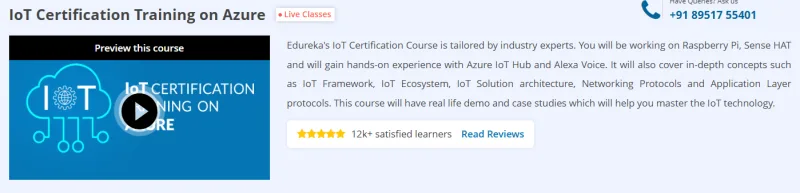
What will you learn in IoT Certification Training on Azure Course
-
Grasp the IoT ecosystem: architecture, frameworks, and solution design on Azure
-
Configure and program Raspberry Pi and Sense HAT: GPIO interfacing, sensor data collection, and Python scripting
-
Build end-to-end IoT solutions with Azure IoT Hub: device provisioning, telemetry ingestion, and message routing
-
Implement edge computing with Azure IoT Edge: deploy modules to Raspberry Pi, perform local analytics, and manage containerized workloads
Program Overview
Module 1: Introduction to Internet of Things
⏳ 2 hours
-
Topics: IoT fundamentals, ecosystem components, decision frameworks, and solution-architecture models
-
Hands-on: Explore major IoT boards and diagram a reference architecture
Module 2: Setting Up Raspberry Pi & Sense HAT
⏳ 2 hours
-
Topics: Raspberry Pi installation, SSH access, Sense HAT programming basics
-
Hands-on: Configure Pi over SSH and program Sense HAT sensors with Python
Module 3: Building IoT Solutions with Raspberry Pi
⏳ 3 hours
-
Topics: Sensor-actuator integration, data streaming to Google Sheets, basic OpenCV for vision tasks
-
Hands-on: Create a weather station, log data to Google Sheets, and build a face-detection app
Module 4: IoT Communication Protocols
⏳ 1.5 hours
-
Topics: MQTT, HTTP, AMQP, CoAP—protocol selection and implementation
-
Hands-on: Publish and subscribe to sensor data over MQTT
Module 5: Implementing IoT with Azure IoT Hub
⏳ 3 hours
-
Topics: Device registration, telemetry ingestion, routing to storage, and dashboarding
-
Hands-on: Register Pi devices, send/receive messages via Azure IoT Hub, visualize data in Azure Storage Explorer
Module 6: Edge Computing & Analytics
⏳ 2 hours
-
Topics: Azure IoT Edge architecture, module deployment, real-time analytics at the edge
-
Hands-on: Deploy IoT Edge modules to Raspberry Pi and analyze streaming sensor data locally
Module 7: Alexa Voice Bot Integration
⏳ 1.5 hours
-
Topics: AWS Alexa Skill development, Pi-Alexa communication, voice-driven IoT control
-
Hands-on: Build and deploy an Alexa skill to query sensor readings and control actuators on Pi
Module 8: Capstone Project – Real-World IoT Solution
⏳ 4 hours
-
Topics: End-to-end design, security considerations, scalability, and future enhancements
-
Hands-on: Architect and implement a complete IoT scenario combining cloud, edge, and voice interfaces
Get certificate
Job Outlook
-
IoT Developer: $100,000–$150,000/year — build and deploy IoT solutions across industries
-
Edge Solutions Engineer: $110,000–$160,000/year — implement edge analytics and containerized workloads
-
Cloud IoT Architect: $120,000–$180,000/year — design secure, scalable IoT architectures on Azure
Explore More Learning Paths
Take your engineering and management expertise to the next level with these hand-picked programs designed to expand your skills and boost your leadership potential.
Related Courses
-
IoT: Internet of Things, Wireless & Cloud Computing, Emerging Technologies Course – Explore the foundations of IoT, wireless systems, and cloud technologies driving the next wave of connected innovation.
-
An Introduction to Programming the Internet of Things (IoT) Specialization Course – Learn to design, code, and deploy IoT applications with hands-on projects and real-world hardware concepts.
-
Emerging Technologies: From Smartphones to IoT to Big Data Specialization Course – Understand how modern technologies—from IoT to big data—shape industries and enable future-ready digital transformation.
Related Reading
-
What Is Project Management? – Understand the principles that make every great project a success story.