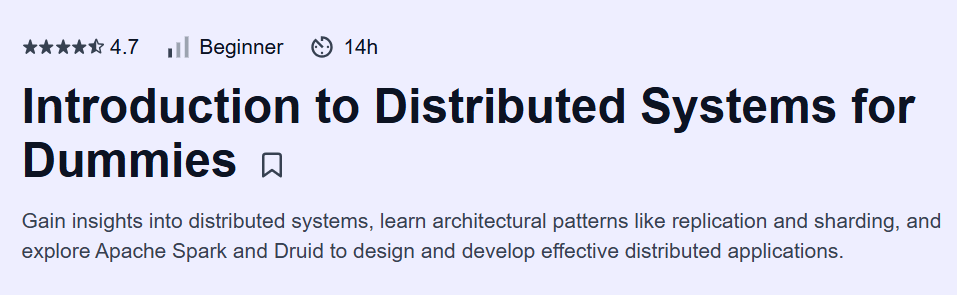
What will you learn in Introduction to Distributed Systems for Dummies Course
-
Distributed systems fundamentals: Define distributed systems, understand their need, and explore core challenges like fault tolerance, reliability, availability, scalability, and maintainability.
-
Data management techniques: Master data replication, partitioning (including consistent hashing), caching, and tunable consistency models.
-
Node communication mechanisms: Learn synchronous and asynchronous messaging, microservices communication, and database-based inter-node coordination.
-
Large-scale processing patterns: Understand batch and stream processing (e.g., MapReduce), Lambda architecture, CQRS, and cloud-scale data workflows.
-
Real-world system deep dives: Examine production-grade case studies on Apache Spark and Apache Druid.
Program Overview
Module 1: What is a Distributed System?
⏳ ~1 hour
-
Topics: Definitions, motivations, examples, and interactive quiz.
-
Hands-on: Build conceptual understanding with quizzes on system properties.
Module 2: Achieving Resilience & Scalability
⏳ ~2.5 hours
-
Topics: Fault tolerance, handling hardware/software failures, availability, load balancing, and maintainability.
-
Hands-on: Quizzes and scenario-based tasks addressing reliability and fault considerations.
Module 3: Data Strategies in Distributed Architectures
⏳ ~3 hours
-
Topics: Data replication methods, partitioning tactics, consistency models, caching strategies.
-
Hands-on: Interactive quizzes on replication, partitioning, and cache eviction policies.
Module 4: Inter-Node Communication
⏳ ~1 hour
-
Topics: Communication via databases, synchronous and asynchronous messaging mechanisms.
-
Hands-on: Quiz-based validation of communication patterns and microservice messaging strategies.
Module 5: Large‑Scale Data Processing
⏳ ~1 hour
-
Topics: Batch and stream processing, MapReduce.
-
Hands-on: Exercises and quizzes on data processing workflows.
Module 6: Architectural Pattern Deep Dive
⏳ ~1 hour
-
Topics: Replication services, sharding, Lambda architecture, CQRS.
-
Hands-on: Practical quizzes illustrating pattern use cases and optimization tactics.
Module 7: Case Study – Apache Spark
⏳ ~45 minutes
-
Topics: Spark basics, architecture for distributed analytics.
-
Hands-on: Real-world scenario walkthrough using Spark cluster design.
Module 8: Case Study – Apache Druid
⏳ ~45 minutes
-
Topics: OLAP vs OLTP, architecture of Druid.
-
Hands-on: Examination of Druid’s ingestion, querying, and scalability.
Module 9: Final Wrap-Up & Best Practices
⏳ ~30 minutes
-
Topics: Best practices, practical guidance, and course summary.
-
Hands-on: Final quiz consolidating key themes and system design wisdom.
Get certificate
Job Outlook
-
Core backend and system design skillset: Crucial for roles like Site Reliability Engineer, Backend Developer, System Architect, and Distributed Engineer.
-
In high demand across sectors: Applicable to cloud infrastructure, big data processing, enterprise systems, and IoT ecosystems.
-
Valued for tech interviews: Strong foundation for system design interviews and technical architecture discussions.
-
Practical portfolio value: Hands-on case studies with Spark and Druid enrich your resume and showcase real-world ability.