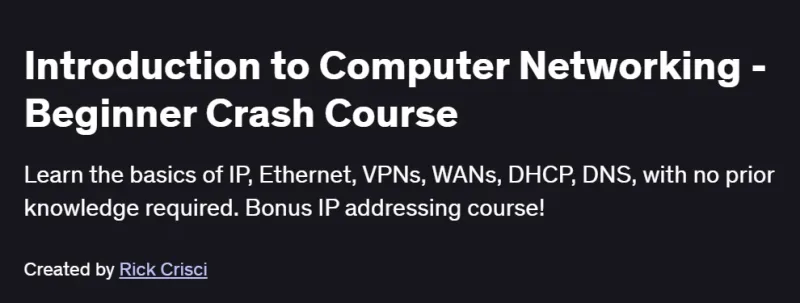
What will you in Introduction to Computer Networking – Beginner Crash Course
- Grasp core networking concepts, models, and terminology.
- Compare and contrast the OSI and TCP/IP models for network communication.
- Configure and manage IP addressing, subnets, and VLANs.
- Understand basic routing and switching principles and device roles.
- Explore wireless networking standards and security fundamentals.
- Diagnose and troubleshoot common network issues using practical tools.
Program Overview
Module 1: Introduction to Networking & Models
⏳ 45 minutes
-
Define networking fundamentals: nodes, media, and protocols.
-
Compare the OSI vs. TCP/IP models and their layers.
-
Explore real-world examples of network traffic flow.
Module 2: Ethernet, LANs & WANs
⏳ 1 hour
-
Understand Ethernet framing and MAC addressing.
-
Configure LAN topologies: star, bus, and ring.
-
Introduce WAN technologies: MPLS, VPN, and leased lines.
Module 3: IP Addressing & Subnetting
⏳ 1 hour
-
Learn IPv4 addressing structure and CIDR notation.
-
Calculate subnet masks and network/host ranges.
-
Intro to IPv6 addressing and transition mechanisms.
Module 4: Switching Fundamentals
⏳ 1 hour
-
Explain switch operation, CAM tables, and frame forwarding.
-
Configure VLANs for network segmentation.
-
Use trunking protocols (802.1Q) to carry multiple VLANs.
Module 5: Routing Basics
⏳ 1 hour
-
Distinguish static vs. dynamic routing.
-
Explore routing tables and packet forwarding decisions.
-
Overview of common protocols: RIP, OSPF, and EIGRP.
Module 6: Wireless Networking & Security
⏳ 45 minutes
-
Compare Wi-Fi standards (802.11a/b/g/n/ac/ax).
-
Configure SSIDs, channels, and encryption methods (WPA2/WPA3).
-
Understand authentication and access control for wireless.
Module 7: Network Security Essentials
⏳ 45 minutes
-
Identify common threats: DDoS, spoofing, and MITM attacks.
-
Implement basic protections: firewalls, ACLs, and port security.
-
Introduce VPNs and secure remote access technologies.
Module 8: Troubleshooting & Diagnostic Tools
⏳ 1 hour
-
Use tools like ping, traceroute, and nslookup for diagnostics.
-
Analyze packet captures with basic Wireshark techniques.
-
Develop a structured approach for identifying and resolving issues.
Get certificate
Job Outlook
- High Demand Roles: Network Technician, Help Desk Specialist, IT Support Engineer.
- Salary Potential: ₹3–8 LPA in India; $50K–$75K annually in the U.S.
- Growth Areas: Enterprise networking, cloud connectivity, and network automation.
- Career Advancement: Foundation for certifications like CompTIA Network+, Cisco CCNA, and Juniper JNCIA.
Explore More Learning Paths
Enhance your networking knowledge and practical skills with these curated courses designed to help beginners and aspiring IT professionals build a strong foundation.
Related Courses
-
Networking in Google Cloud Fundamentals Course – Learn how networking works in cloud environments and gain hands-on experience with Google Cloud networking tools.
-
Computer Security and Systems Management Specialization Course – Understand how to manage computer systems securely and maintain network integrity.
-
The Bits and Bytes of Computer Networking Course – Dive deep into networking fundamentals, protocols, and practical applications to strengthen your IT skills.
Related Reading
-
What Is Data Management – Explore how structured data management supports secure and efficient networking practices.