9.6/10
Highly Recommended
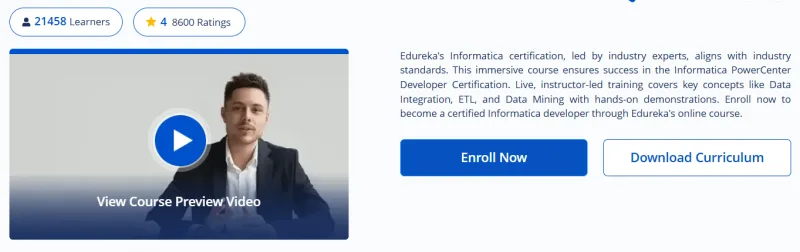
Informatica Certification Training Course on Edureka — This course delivers a balanced mix of tool fundamentals and advanced techniques, preparing you to design, optimize, and administer robust ETL pipelines in production environments.
Pros
- Hands-on labs cover all key PowerCenter components and transformations
- Strong focus on performance tuning and real-world optimization
- Includes administration and security modules for end-to-end readiness
Cons
- Assumes familiarity with BI concepts and basic SQL
- Limited coverage of cloud-native Informatica offerings (IICS)
Informatica Certification Training Course Course
Platform: Edureka
Instructor: Unknown
What will you learn in Informatica Certification Training Course
-
Grasp Informatica PowerCenter architecture and core components (Repository Service, Integration Service, Client Tools)
-
Design and develop ETL mappings using Source Qualifier, Lookup, Aggregator, Router, and other transformations
-
Build reusable mapping parameters, variables, and mapplets for scalable workflows
-
Implement workflow control: sessions, tasks, event-based triggers, and recovery strategies
-
Optimize performance with partitioning, pushdown optimization, and tuning best practices
-
Monitor and administer Informatica domains, repositories, and security
Program Overview
Module 1: Introduction to Informatica & Environment Setup
⏳ 1 week
-
Topics: PowerCenter components, server vs. client installation, repository architecture
-
Hands-on: Install PowerCenter, configure repository and integration services, and connect via Designer
Module 2: Data Transformation & Mapping Development
⏳ 1 week
-
Topics: Source definitions, target definitions, and transformation types (active vs. passive)
-
Hands-on: Create a basic mapping with Expression, Filter, and Sequence Generator transformations
Module 3: Lookup, Joiner & Aggregator Transformations
⏳ 1 week
-
Topics: Static vs. dynamic lookup, sorted vs. unsorted input, join strategies, aggregate logic
-
Hands-on: Build mappings using Lookup to enrich data, Joiner for heterogenous sources, and Aggregator for rollups
Module 4: Workflow Creation & Control Tasks
⏳ 1 week
-
Topics: Workflow Manager, sessions, command tasks, email tasks, event wait tasks
-
Hands-on: Design workflows with branching logic, parameter files, and event-based triggers
Module 5: Mapplets, Parameters & Variables
⏳ 1 week
-
Topics: Creating mapplets, using parameters and variables for dynamic behavior
-
Hands-on: Build reusable mapplets and configure workflow parameter files for multiple environments
Module 6: Performance Tuning & Optimization
⏳ 1 week
-
Topics: Pushdown optimization, partitioning strategies, cache sizing, optimizer hints
-
Hands-on: Analyze session logs to identify bottlenecks and apply tuning techniques
Module 7: Administration & Security
⏳ 1 week
-
Topics: Domain vs. repository administration, user roles, folder-level security, connections management
-
Hands-on: Create and manage users/groups, assign roles, and secure folders and objects
Module 8: Advanced Topics & Capstone Project
⏳ 1 week
-
Topics: Real-time data ingestion with PowerExchange, metadata reporting, recovery best practices
-
Hands-on: Design an end-to-end ETL solution with real-time source, transformations, and error handling
Job Outlook
-
Informatica skills are in high demand for Data Integration, ETL Developer, and Data Warehouse Architect roles
-
Widely used in finance, healthcare, telecom, and retail for enterprise-grade data solutions
-
Salaries range from $85,000 to $140,000+ based on experience and region
-
Expertise in Informatica complements careers in BI, analytics, and cloud data engineering
FAQs
How much SQL or database knowledge do I need before starting this course?
The course often assumes you have a basic understanding of SQL (SELECT, JOIN, GROUP BY) to follow ETL & data manipulation lessons. You’ll benefit from familiarity with relational database concepts like tables, keys, and normalization. Advanced SQL (window functions, subqueries) may not be a pre-requirement but will help you go faster. Many learners who start with weak SQL skills spend extra time catching up on those concepts. The instructors usually provide refresher materials or mini-modules on SQL basics.
Will I get hands-on access to an Informatica environment or lab infrastructure?
Yes, most quality Informatica certification courses include access to virtual labs or sandbox environments. You’ll be able to install, configure, and use PowerCenter tools, like Designer, Workflow Manager, Repository Manager. These labs allow you to practice building mappings, workflows, sessions, and error handling. The environment is typically temporary (cloud VM, shared lab) so save your work frequently. Some courses may require you to configure your own local environment as an extension exercise.
How much focus is given to performance tuning and optimization?
The course usually includes a dedicated module on performance tuning for mappings and workflows. You’ll learn techniques like pushdown optimization, partitioning, caching, and buffer memory settings. Lessons often compare tuning for different transformation types, and when to avoid expensive operations. Practical exercises allow you to measure before/after effects of tuning changes. However, in-depth enterprise-level tuning (for high-scale clusters) may not be fully covered.
Does the course cover real-time or near real-time data integration using Informatica?
Many Informatica training programs include sections on real-time integration or incremental loads. You may learn using techniques like change data capture (CDC), event-driven workflows, or listener tasks. The course might contrast batch workflows and real-time data streaming scenarios. Practical labs could include setting up near real-time pipelines or handling small latency requirements. If not covered, these topics are good extension areas to explore after completing the course.
After finishing this course, what types of roles can I realistically apply for?
You can aim for roles such as Informatica Developer / ETL Developer or Data Integration Engineer. Smaller companies may offer junior roles, where you’ll handle mappings, workflows, and data pipelines. With experience, you can progress to Informatica Administrator or Data Warehouse Engineer roles. The certification boosts credibility and helps your resume—employers often prefer candidates who can show hands-on ETL skills. Real-world experience (projects, portfolio) combined with this training is key to getting hired.