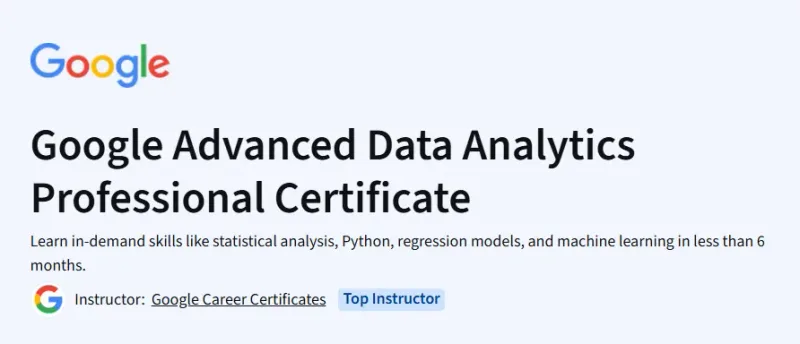
What will you learn in Google Advanced Data Analytics Professional Certificate Course
-
Apply Python, Jupyter Notebook, and Tableau for data cleaning, visualization, and business storytelling.
-
Conduct exploratory data analysis (EDA), statistical modeling, hypothesis testing, regression, and predictive modeling.
-
Build and evaluate linear/logistic regression models, assess with ANOVA, chi‑square, and more.
-
Develop foundational machine learning skills including naive Bayes and decision trees.
Program Overview
Module 1: Foundations of Data Science
⏳ ~21 hours
-
Topics: Introduction to data science, PACE (Plan-Analyze-Construct-Execute) workflow, data professional roles, foundational analytics tools.
-
Hands-on: Core project using PACE and foundational assessments.
Module 2: Python for Data Analysis
⏳ ~20 hours
-
Topics: Python syntax, data structures (lists, dictionaries), pandas and NumPy for data manipulation.
-
Hands-on: Extensive hands-on Python labs and quizzes.
Module 3: Translate Data into Insights
⏳ ~30 hours
-
Topics: Exploratory Data Analysis (EDA), best practices, visual storytelling using Tableau and Python.
-
Hands-on: Build dashboards, interpret insights, and complete real-world scenarios.
Module 4: The Power of Statistics
⏳ ~20 hours
-
Topics: Probability distributions, hypothesis testing, A/B testing, experimental design.
-
Hands-on: Apply statistical tests and complete analytical assignments.
Module 5: Regression Analysis ⏳ ~20 hours
-
Topics: Linear and logistic regression models, coefficient interpretation, ANOVA, chi-square.
-
Hands-on: Regression modeling tasks using Python.
Module 6: Machine Learning Fundamentals
⏳ ~20 hours
-
Topics: Naive Bayes, decision trees, basics of supervised learning workflows.
-
Hands-on: Implement models and evaluate performance.
Module 7: Capstone Project
⏳ ~30 hours
-
Topics: Apply cumulative learning to a simulated real-world business challenge—analysis, modeling, reporting.
-
Hands-on: Complete capstone deliverables for portfolio inclusion (optional but useful).
Get certificate
Job Outlook
-
Designed for roles such as Senior Data Analyst, Junior Data Scientist, and Data Science Analyst.
-
Median salary is around USD 118,000; strong demand with over 84,000 openings in the field.
-
Best suited for learners with prior analytics experience (or completion of the Google Data Analytics Certificate).
Explore More Learning Paths
Elevate your data analytics expertise with these hand-picked programs designed to strengthen your skills in data analysis, visualization, and business intelligence.
Related Courses
-
Google Data Analytics Professional Certificate Course – Build a comprehensive foundation in data analytics, including data cleaning, visualization, and interpretation for real-world decision-making.
-
Introduction to Data Analytics Course – Learn fundamental concepts in data analytics, covering key techniques and practical applications.
-
Introduction to Data Analytics for Business Course – Apply data analytics techniques to business scenarios, enhancing insights, strategy, and operational efficiency.
Related Reading
-
What Is Data Management? – Understand how effective data management supports accurate analytics and business intelligence.