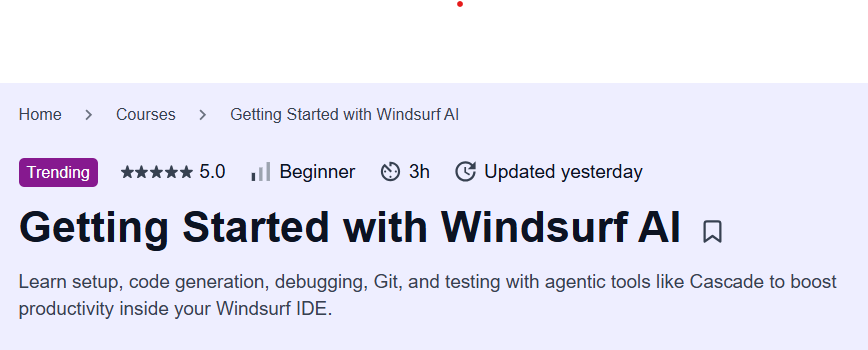
Getting Started with Windsurf AI Course

Getting Started with Windsurf AI Course Course

This concise Educative course demystifies Windsurf AI, delivering focused, hands-on lessons that enable you to build, monitor, and deploy complex AI pipelines in under four hours. It’s ideal for devel...

Explore This Course Quick Enroll Page
9.6/10 Highly Recommended

Getting Started with Windsurf AI Course on Educative — This concise Educative course demystifies Windsurf AI, delivering focused, hands-on lessons that enable you to build, monitor, and deploy complex AI pipelines in under four hours. It’s ideal for developers and data engineers looking to automate LLM-centric tasks.

Pros

  • Very concise—complete pipeline automation in under four hours
  • Strong code-first approach with immediate feedback in-browser
  • Covers end-to-end workflow: ingestion, LLM calls, logic, and deployment

Cons

  • Assumes familiarity with Python and basic LLM concepts
  • No deep dive into scaling workflows across distributed systems

Getting Started with Windsurf AI Course Course

Platform: Educative

Instructor: Developed by MAANG Engineers

What will you learn in Getting Started with Windsurf AI Course

  • Understand Windsurf AI’s architecture and core features for building AI-driven workflows.

  • Install and configure Windsurf AI in your Python environment.

  • Ingest and preprocess data, including text, CSV, and JSON sources.

​​​​​​​​​​

  • Design and execute pipelines that chain prompts, LLM calls, and custom Python functions.

  • Implement branching logic, error handling, and conditional flows in Windsurf workflows.

  • Visualize and monitor your AI workflows, capturing logs and performance metrics.

Program Overview

Module 1: Introduction to Windsurf AI

⏳ 0.5 hours

  • Topics: Overview of Windsurf AI, use cases, and installation.

  • Hands-on: Install the Windsurf package, explore example repositories, and verify your setup.

Module 2: Data Ingestion & Preprocessing

⏳ 1 hour

  • Topics: Loading CSV, JSON, and text into Windsurf; basic cleaning and normalization.

  • Hands-on: Build a data ingestion pipeline that reads a CSV, filters rows, and outputs a cleaned DataFrame.

Module 3: Prompt Chains & LLM Integration

⏳ 1 hour

  • Topics: Defining prompt templates, chaining multiple LLM calls, and handling responses.

  • Hands-on: Create a prompt chain that summarizes text, translates it, and extracts key entities.

Module 4: Custom Functions & Branching Logic

⏳ 1 hour

  • Topics: Embedding Python functions as nodes, conditional branches, loops, and error handling.

  • Hands-on: Implement a pipeline that routes items based on sentiment score using a conditional branch.

Module 5: Monitoring, Visualization & Logging

⏳ 0.5 hours

  • Topics: Built-in dashboard, log capturing, metrics collection, and basic visualization.

  • Hands-on: Run a sample workflow and view its execution graph, logs, and performance metrics.

Module 6: Deployment & Reuse

⏳ 0.5 hours

  • Topics: Packaging workflows as CLI commands, exporting to Docker, and sharing pipelines.

  • Hands-on: Package your pipeline into a CLI tool and run it against new data inputs.

Get certificate

Job Outlook

  • Workflow automation specialists and AI engineers with pipeline orchestration skills are in rising demand.

  • Roles such as AI Workflow Engineer, Automation Developer, and Data Pipeline Architect typically command $90K–$130K USD.

  • Expertise in tools like Windsurf AI complements knowledge of Airflow, Prefect, and Kubeflow for a well-rounded automation profile.

  • Companies in tech, finance, healthcare, and e-commerce seek talent to streamline AI-driven business processes.
FAQs

Do I need prior AI experience to take this course?
Basic Python knowledge is required; familiarity with LLMs is recommended. No deep AI expertise is necessary to build simple workflows. The course focuses on practical pipeline creation and automation. Hands-on exercises help understand data ingestion, prompt chaining, and deployment. Ideal for developers and data engineers looking to automate AI tasks quickly.
Can I deploy AI workflows built in Windsurf AI to production?
Yes, workflows can be packaged as CLI tools or exported via Docker. Deployment includes monitoring, logging, and basic performance visualization. Designed for small to medium-scale pipeline automation. Scaling across distributed systems is not covered in depth. Provides a strong foundation for integrating with larger orchestration tools.
Which industries benefit most from Windsurf AI skills?
Tech companies using LLM-driven workflows. Finance, healthcare, and e-commerce for AI-driven process automation. Data engineering and workflow automation roles. Startups looking to quickly integrate AI into business pipelines. Any organization aiming to streamline AI-based tasks.
How does this course differ from general AI workflow tutorials?
Focused specifically on Windsurf AI rather than generic workflow automation tools. Covers end-to-end pipeline: data ingestion, LLM calls, branching logic, and deployment. Includes hands-on monitoring, visualization, and logging. Very concise: complete pipelines can be built in under four hours. Unlike general tutorials, it combines coding, LLM integration, and real-world pipeline deployment.
What career opportunities can this course enable?
AI Workflow Engineer. Automation Developer. Data Pipeline Architect. Workflow automation specialists typically earn $90K–$130K USD. Skills complement knowledge of Airflow, Prefect, or Kubeflow for broader pipeline management roles.

Similar Courses

Other courses in Information Technology Courses