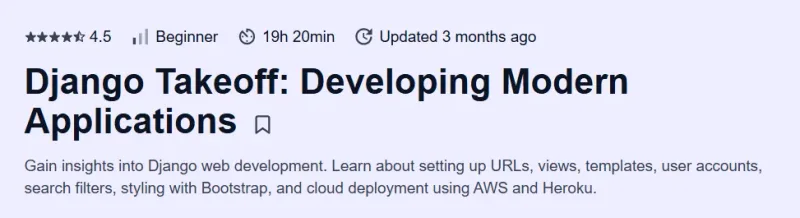
What will you learn in Django Takeoff: Developing Modern Applications Course
-
Architect and build full-featured web applications using the Django framework.
-
Model relational data with Django’s ORM and perform CRUD operations.
-
Create dynamic user interfaces with Django templates and context rendering.
-
Handle user input and validation through Django forms.
-
Implement authentication, authorization, and user session management.
-
Expose data via RESTful APIs using Django REST Framework.
Program Overview
Module 1: Getting Started with Django
⏳ 1.5 hours
-
Topics: Project setup, app structure, settings configuration.
-
Hands-on: Initialize a Django project, run the development server, and explore the admin interface.
Module 2: Models and Databases
⏳ 2 hours
-
Topics: Defining models, migrations, relationships, and querying.
-
Hands-on: Design data schemas, create migrations, and interact with the database via the shell.
Module 3: Views and Templates
⏳ 2 hours
-
Topics: Function- and class-based views, URL routing, template inheritance.
-
Hands-on: Build dynamic pages with context data and reusable template blocks.
Module 4: Forms and User Input
⏳ 1.5 hours
-
Topics: Django forms, model forms, validation, and error handling.
-
Hands-on: Create forms for creating and updating model instances, and display validation errors.
Module 5: Authentication and Authorization
⏳ 2 hours
-
Topics: User model, login/logout, permissions, and decorators.
-
Hands-on: Implement user registration, login workflows, and role-based access control.
Module 6: Building REST APIs
⏳ 2.5 hours
-
Topics: Django REST Framework setup, serializers, viewsets, and routers.
-
Hands-on: Expose model data via JSON endpoints and test with API clients.
Module 7: Deployment and Security
⏳ 2 hours
-
Topics: WSGI/ASGI, static and media files, environment variables, HTTPS.
-
Hands-on: Deploy your app to a cloud platform, configure Gunicorn, Nginx, and secure settings.
Module 8: Capstone Project – Real-World App
⏳ 3 hours
-
Topics: End-to-end development of a sample blog or e-commerce app.
-
Hands-on: Integrate all learned features—models, views, forms, auth, and APIs—into a cohesive project.
Get certificate
Job Outlook
-
Django skills are in strong demand for roles like Backend Developer, Full-Stack Engineer, and Web Application Developer.
-
Entry-level salaries typically range from $70K–$95K, with experienced developers earning $100K+ in tech hubs.
-
Django proficiency opens opportunities in startups, agencies, and enterprise environments.
-
Knowledge of REST APIs, security practices, and deployment pipelines enhances career growth in web engineering.
Explore More Learning Paths
Boost your web development skills and master modern application building with Django through these carefully selected courses designed to strengthen your Python and web application expertise.
Related Courses
-
Django for Everybody Specialization Course – Learn Django fundamentals and advanced web development techniques to build dynamic web applications.
-
Python Django Certification Training Course – Gain hands-on experience in Python and Django, from backend development to deployment.
-
Web Application Technologies and Django Course – Explore modern web technologies and Django frameworks to create robust and scalable applications.
Related Reading
-
What Is Python Used For – Understand how Python serves as the backbone for web development, application building, and automation.